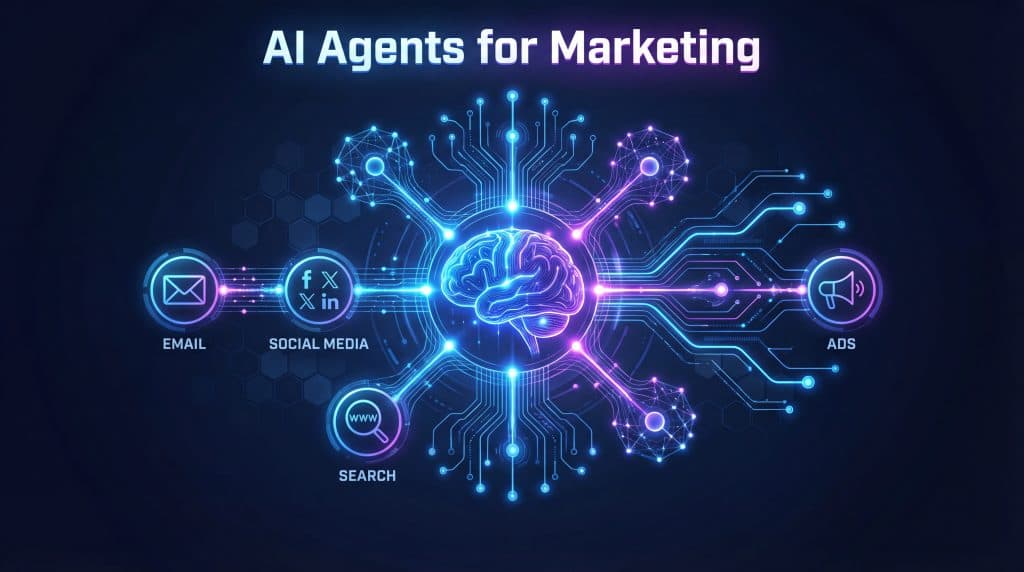
The ROI of AI Agents for Marketing: What the Numbers Say
The business case for agentic marketing is backed by hard numbers from 2025 and early 2026 data:
74% of executives report achieving ROI within the first year of deploying AI agents.
39% of executives reporting productivity gains say productivity has at least doubled.
37% average cost savings in marketing operations for businesses using AI agents.
3-15% revenue uplift with sales ROI rising 10-20% across organizations using agentic systems.
$0.8-$1.2 trillion in annual value that GenAI could unlock across sales and marketing globally.
These aren’t theoretical projections. Businesses using agentic AI in their marketing stack are already reporting measurable improvements in campaign performance, team efficiency, and cost reduction. The key driver is that agents handle the repetitive, data-heavy tasks – freeing up your team to focus on creative strategy and brand building, which are still inherently human strengths.
How to Implement Agentic AI in Your Marketing Stack: A Practical Roadmap
Deploying marketing AI agents successfully requires more than just buying a platform. Here’s a step-by-step approach that marketing teams are using in 2026:
Step 1: Audit Your Current Workflow
Map out every tool, process, and handoff in your marketing stack. Identify where the most time is spent on repetitive tasks – content production, reporting, campaign setup, A/B test management. These are your highest-ROI automation targets. Most marketing teams discover they’re using 7-10+ disconnected tools, each requiring manual data transfer between them.
Step 2: Define Goals and Guardrails
AI agents work best when they have clear objectives and boundaries. Define what success looks like (lower CPA, higher content output, faster campaign launches) and set the guardrails (brand guidelines, budget limits, approval requirements). The best agentic marketing platforms let you encode your brand standards directly into the system. MarqOps does this through its Brand Intelligence DNA feature, which ensures every output – from ad copy to blog posts – stays aligned with your brand identity.
Step 3: Start with One High-Impact Use Case
Don’t try to automate everything at once. Pick a single use case where AI agents can deliver quick, measurable results. Content production and SEO are popular starting points because they’re time-intensive and the quality improvements are easy to measure. Once you’ve proven the model, expand to ad optimization, reporting, and multi-channel orchestration.
Step 4: Integrate Your Data Sources
AI agents are only as good as the data they can access. Connect your CRM, analytics platforms, ad accounts, email tools, and customer data platforms. The more unified your data, the more intelligent your agents become. This is where consolidated platforms have a significant advantage over point solutions – when everything lives in one system, the agents don’t need to reconcile conflicting data from multiple sources.
Step 5: Monitor, Learn, and Scale
Track agent performance against your KPIs. Review the decisions the agents make, not just the outcomes. As your team builds confidence and the agent learns your preferences, gradually expand its autonomy. The goal is a human-in-the-loop partnership where AI handles execution while humans focus on strategy and creative direction.
What to Look for in an Agentic Marketing Platform
Not all agentic platforms are created equal. When evaluating solutions for your team, prioritize these capabilities:
Multi-channel execution: The platform should manage content, SEO, paid ads, email, and social from a single interface – not require separate tools for each channel.
Brand intelligence: Look for systems that learn and enforce your brand guidelines automatically. If you have to manually check every AI output for brand consistency, you’re losing most of the efficiency gains.
Transparent decision-making: You should be able to see why an agent made a specific decision – which data it used, what alternatives it considered, and what confidence level it had. Black-box systems create trust issues.
Agent-to-agent communication: As the agentic ecosystem matures, your marketing agents will need to interact with agents from commerce platforms, CRMs, and ad networks. Interoperability matters.
Multi-model AI pipeline: The best platforms don’t lock you into a single AI model. They route tasks to the best model for each job – one model for creative writing, another for data analysis, a third for image generation. This multi-model approach, which leading AI agent platforms are adopting, prevents vendor lock-in and delivers superior output quality.
Enterprise security: SOC 2 compliance, GDPR readiness, and data isolation are non-negotiable for marketing teams handling customer data. Make sure the platform meets your organization’s security requirements.
The Future of Agentic Marketing: What’s Coming Next
The agentic marketing landscape is evolving rapidly. Here are the trends that will shape the rest of 2026 and beyond:
Agentic commerce takes off: With the launch of standardized commerce protocols, AI agents will increasingly handle the full purchase journey – from discovery to transaction. Marketers who adapt their strategies for agent-mediated commerce early will have a significant first-mover advantage.
Agents building agents: We’re already seeing meta-agents that can configure and deploy specialized marketing agents for specific tasks. Instead of a human configuring each workflow, a master agent spins up task-specific sub-agents, manages their coordination, and optimizes the entire system.
Search optimization shifts to AI visibility: As AI-powered search becomes the default interface, marketing agents will optimize not just for traditional rankings but for AI citation and visibility. Getting your brand cited in AI-generated answers is becoming as important as ranking on page one.
Unified analytics replace fragmented dashboards: The days of logging into five different platforms to understand campaign performance are ending. AI agents pull data from every source, analyze it holistically, and deliver insights through a single conversational interface.
Frequently Asked Questions About AI Agents for Marketing
What are AI agents for marketing?
AI agents for marketing are autonomous software systems that can plan, execute, and optimize marketing campaigns with minimal human intervention. Unlike traditional automation tools that follow predefined rules, AI agents operate on goals and context – adapting their approach in real time based on performance data and changing conditions.
How much do AI agents for marketing cost?
Costs vary widely depending on the platform and scope. Some platforms charge per agent or per task, while consolidated solutions like MarqOps offer subscription-based pricing that covers multiple marketing functions. The key metric is ROI – 74% of executives report achieving ROI within the first year, with average cost savings of 37% in marketing operations.
Will AI agents for marketing replace human marketers?
No. AI agents handle execution, data analysis, and optimization at scale – tasks that consume most of a marketer’s time today. This frees up human marketers to focus on strategic planning, creative direction, brand storytelling, and the nuanced relationship-building that AI cannot replicate. The best results come from a human-in-the-loop model where agents and marketers collaborate.
What’s the difference between AI agents and AI chatbots in marketing?
AI chatbots are designed for conversational interactions – answering customer questions or qualifying leads. AI agents are much broader in scope. They can manage entire campaigns, optimize ad spend, generate content, analyze data, and coordinate actions across multiple marketing channels. A chatbot is one type of AI agent, but AI agents for marketing encompass a much wider range of autonomous capabilities.
How do I get started with AI agents for digital marketing?
Start by auditing your current marketing stack and identifying the most time-consuming repetitive tasks. Pick one high-impact area – like content production or ad optimization – and deploy an AI agent there first. Choose a platform that supports your existing tools and data sources. MarqOps offers a free tier that lets teams experience AI-powered marketing operations across content, SEO, ads, and analytics from a single dashboard.