TL;DR
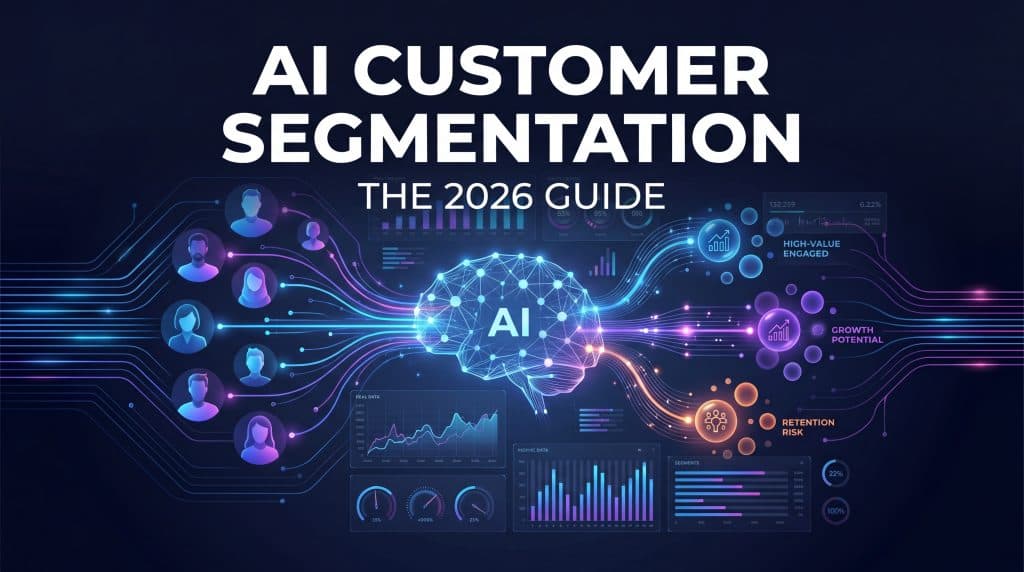
- AI customer segmentation uses machine learning to group customers by behavior, intent, and predicted value, replacing static demographic buckets with segments that update in real time.
- AI-driven segments boost personalization effectiveness by 33%, lift conversions up to 50%, and can drive segmented marketing revenue gains as high as 760% (Mailchimp, McKinsey).
- The four core models you need to know: RFM clustering, behavioral segmentation, predictive lifetime value, and churn-risk segmentation.
- Most teams hit a wall because their data lives in 7+ disconnected tools. A unified platform like MarqOps fixes that with Brand Intelligence DNA and one connected analytics layer.
- Start with one high-stakes use case (re-engagement, upsell, or churn) before rolling segmentation across the full lifecycle.
Table of Contents
- What Is AI Customer Segmentation?
- AI Customer Segmentation vs. Traditional Segmentation
- How AI Customer Segmentation Actually Works
- The 4 Core AI Segmentation Models
- Benefits and Real Revenue Impact
- 7 High-Value Use Cases for Marketing Teams
- A 6-Step Implementation Playbook
- Tools and Platforms for AI Customer Segmentation
- Common Challenges (and How to Avoid Them)
- The Future: Generative AI and Agentic Segmentation
- FAQs
What Is AI Customer Segmentation?
AI customer segmentation is the use of machine learning, predictive models, and increasingly autonomous agents to group customers by behavior, intent, and predicted value, then keep those groups updated automatically as new signals arrive. Instead of marketers writing rules like “women aged 25 to 34 in California,” AI looks at hundreds of signals across browsing, purchase, support, email, and ad data, then surfaces the segments that actually drive revenue.
The shift is significant. About 88% of marketers now use AI tools daily, and 56% of companies are actively implementing AI in marketing workflows according to recent industry reports. Customer segmentation is consistently one of the top three use cases, alongside content generation and predictive analytics. The reason is simple: traditional segments age fast, and AI keeps them fresh.
Why this matters in 2026: AI advertising spend is projected to rise more than 60% by 2026, and the AI-powered customer segmentation market itself is forecast to grow from $1.4 billion in 2020 to $5.6 billion by 2025 at a 25.6% CAGR. Marketers who still segment manually are competing with teams whose segments refresh every minute.
AI Customer Segmentation vs. Traditional Segmentation
Traditional segmentation typically starts from a guess. A marketer picks a few demographic or geographic buckets, ships them to an email or ad platform, and revisits the segments quarterly at best. The buckets are static, the data is partial, and the moment a customer crosses a threshold (first purchase, churn risk, upgrade signal), the segment does not move with them.
AI segmentation replaces those guesses with data. According to industry analyses, AI improves segmentation accuracy by up to 85% compared to manual methods, and organizations using AI-powered personalization report 20 to 30% higher marketing ROI versus traditional approaches. Here is the practical difference:
| Dimension | Traditional Segmentation | AI Customer Segmentation |
|---|---|---|
| Inputs | 5 to 10 attributes (age, location, channel) | Hundreds of behavioral, transactional, and intent signals |
| Update cadence | Quarterly or campaign-based | Real time or near real time |
| Method | Rules written by marketers | Clustering, classification, and predictive models |
| Personalization lift | Limited, broad-stroke | Up to 33% effectiveness gain |
| Best for | Awareness, broad reach | Conversion, retention, LTV growth |
If you are still building campaigns from spreadsheet exports and gut-feel cohorts, you are leaving meaningful revenue on the table. The same teams that win at AI personalization in marketing usually win at segmentation first. The two are inseparable.
How AI Customer Segmentation Actually Works
Under the hood, AI customer segmentation runs through a fairly standard pipeline. Understanding it helps you have honest conversations with your data team and avoid overpaying for tools that are mostly marketing fluff.
1. Data ingestion and unification
The model ingests events, attributes, transactions, support tickets, ad impressions, and product usage. The hard part is not the model. It is unifying data across your CRM, CDP, ad platforms, email tool, web analytics, and product database. This is where most segmentation projects stall, and where a unified marketing tech stack earns its keep.
2. Feature engineering
Raw events become useful features: time since last visit, average order value over 90 days, product category affinity, page-depth distribution, support sentiment scores, and so on. Modern platforms automate this with prebuilt feature stores, but the choice of features still drives segment quality.
3. Model training
Most teams start with unsupervised clustering (K-means, hierarchical clustering, DBSCAN) on RFM features to discover natural groupings. From there, supervised models like random forests, gradient boosting, or neural networks predict outcomes such as churn, lifetime value, or next-best-offer. Recent academic work shows deep architectures like LSTM and GRU achieving 99%+ accuracy on churn prediction tasks against traditional logistic regression baselines.
4. Real-time activation
Segments are pushed to ad platforms, email tools, push notification services, and on-site personalization engines. The user who crosses a purchase-likelihood threshold moves into a high-intent segment immediately, no marketer pressing a button.
5. Continuous learning
As new behavior arrives, models retrain. Segments shrink, grow, and reshape themselves. This is the part traditional segmentation simply cannot do.
Want a deeper view of what powers all this? Read our companion guide on predictive marketing analytics for the forecasting techniques that feed segment scoring.
The 4 Core AI Customer Segmentation Models
Most production deployments of AI customer segmentation revolve around four model families. You do not need a PhD to use them, but you should know which one is the right fit for the question you are trying to answer.
1. RFM clustering (Recency, Frequency, Monetary)
RFM is the workhorse of behavioral segmentation. It scores each customer on three axes: how recently they purchased, how often they buy, and how much they spend. K-means clustering on those scores surfaces archetypes like “champions,” “at-risk loyalists,” and “hibernating low-value.” It is simple, defensible, and a strong starting point for most ecommerce and subscription teams.
2. Behavioral and intent segmentation
Goes beyond purchase history to include session behavior, content consumption, feature usage, and engagement patterns. Think SaaS power users vs. trial drop-offs, or media subscribers who consume four articles a week vs. monthly skimmers. AI segmentation works best here because the signal volume is enormous and the patterns are non-obvious.
3. Predictive lifetime value (CLV) segmentation
Uses regression and gradient boosting models to forecast each customer’s future value. You then segment by predicted CLV bands, focusing acquisition spend and VIP treatment on the top decile. This is one of the highest-leverage uses of predictive marketing analytics in the entire stack.
4. Churn-risk segmentation
Classification models flag customers whose behavior matches historical churn patterns. In telecom, predictive churn segmentation has been shown to reduce churn by up to 30%. Combined with sentiment analysis on support tickets and reviews, you get an early-warning system that traditional segmentation simply cannot match.
Pro tip: Do not try to deploy all four model families at once. Start with the one tied to your most painful business metric, ship it, prove the lift, then expand. Teams that try to boil the ocean usually ship nothing for nine months.
Benefits and Real Revenue Impact of AI Customer Segmentation
The numbers behind AI customer segmentation are not hype. They are documented across multiple credible studies, and they are the reason this category is growing so fast.
A few more data points worth pinning to the wall before your next budget meeting:
- 75% of companies report improved customer engagement after deploying AI-powered segmentation, with 65% seeing direct sales increases.
- McKinsey found that companies excelling at segmentation see up to 10% higher revenue growth than competitors.
- Retention lift: AI-powered segmentation can boost customer retention rates by up to 20% and revenue by up to 15%.
- Marketing waste: AI cuts marketing spend wastage by 28% through more precise targeting, which compounds across every channel.
- Bellwether case studies: Amazon’s recommendation engine drives 35% of total revenue. Walmart reports 25% retention gains. Uber saw a 10% conversion rate lift after AI segmentation rollout.

AI customer segmentation: revenue impact and 2026 adoption snapshot.
7 High-Value Use Cases for Marketing Teams
AI customer segmentation gets interesting when you apply it to specific revenue or retention plays. Here are the seven that consistently produce the largest lifts for the teams we talk to.
- Win-back campaigns: Identify lapsed customers most likely to reactivate and route them into tailored offers automatically.
- Cart abandonment: Score abandoners by purchase intent and send progressively richer incentives to high-likelihood, low-intent users.
- Upsell and cross-sell: Predict next-best-product per customer and feed those segments to email, in-app, and ad channels.
- Churn prevention: Surface at-risk segments before they churn and deploy targeted retention journeys.
- Acquisition lookalikes: Build seed audiences from your top-CLV segment and feed them to Meta, Google, and TikTok for sharper lookalikes.
- Lifecycle email orchestration: Use AI segments to power onboarding, education, and re-engagement flows that adapt to behavior. See our best AI email marketing tools guide.
- Creative and offer testing: Pair segments with creative automation to deliver segment-specific variants at scale.
Tired of segmenting customers across 7 disconnected tools?
MarqOps unifies your customer data, AI segmentation, creative production, and analytics in one Brand Intelligence platform. One dashboard, brand-perfect output, 6x faster execution.
A 6-Step Implementation Playbook for AI Customer Segmentation
If you are starting from scratch, here is a battle-tested sequence that keeps the project from collapsing under its own weight.
Step 1: Pick one revenue question, not five
Examples: “How do we recover 15% of the revenue we lose to churn each quarter?” or “Which 10% of our customers should our paid team go heavy on?” Specific questions produce shippable segments.
Step 2: Audit your data sources
List every system holding customer data: CRM, CDP, web analytics, product database, ad platforms, support, payment processor. Identify the joins (typically email or user_id) and the freshness of each source. This is the unsexy work that determines 70% of your eventual results.
Step 3: Choose your model approach
Match the model to the question. Churn? Classification. CLV? Regression. Discovery? Clustering. Resist the urge to use the fanciest model. Random forests beat deep neural networks on most segmentation tasks unless you have millions of rich rows.
Step 4: Build a small, validated set of segments
Five to seven segments is usually plenty. More than that and your operations team will quietly stop using them. Validate each segment by running a holdout cohort and confirming the predicted behavior actually shows up.
Step 5: Activate, measure, iterate
Push segments to the channels where they will pay off first (usually email and paid social). Set up a dashboard that ties segment-level engagement back to revenue. We covered the structure of that view in our marketing dashboard guide.
Step 6: Connect to attribution
Segments without attribution leave you guessing about ROI. Pair AI segmentation with multi-touch attribution so you can prove the lift instead of arguing about it.
Tools and Platforms for AI Customer Segmentation in 2026
The vendor landscape has consolidated meaningfully. Most teams will choose between four categories.
- Customer Data Platforms (CDPs): Segment, Twilio, Treasure Data, Tealium. Strong at unification, decent at activation, light on creative ops.
- Marketing engagement platforms: Braze, Klaviyo, Mailchimp, Adobe Marketo. Good for execution, segments often live in silos.
- Pure-play AI segmentation tools: Pecan, Faraday, Optimove. Powerful models, narrow scope.
- Unified marketing operations platforms: MarqOps and similar systems combine segmentation, content generation, paid advertising, SEO, and analytics in a single Brand Intelligence layer. The pitch is simple: one platform replaces 7+ disconnected tools, content ships 6x faster, and your segments stay in sync with your creative and ad operations.
If you are evaluating options, start with our best marketing automation tools comparison and the marketing intelligence platform guide for the deeper architecture conversation.
Common Challenges (and How to Avoid Them)
- Data fragmentation: If your data lives in 7+ tools, your AI segmentation will only ever see 7 partial views. Solve unification first or accept underwhelming results.
- Black-box models: Marketers struggle to act on segments they cannot explain. Pick tools that surface feature importance and segment definitions in plain language.
- Privacy and compliance: GDPR, CCPA, and emerging state laws constrain how you train and activate. Bake consent management into your data layer from day one.
- Channel sprawl: Building beautiful segments that never reach the customer is a common failure mode. Activation infrastructure matters more than model accuracy.
- Bias and over-segmentation: Models can amplify historical biases or carve customers into segments too small to act on. Guardrails and human review are non-negotiable.
The Future: Generative AI and Agentic Segmentation
The next wave of AI customer segmentation is being shaped by two forces: generative AI in marketing and the rise of agentic systems. Generative models translate plain-language prompts (“show me high-CLV customers in the Northeast who churned in the last 60 days”) into segment definitions you can actually deploy. Agentic AI takes it further: autonomous agents that monitor segments, propose interventions, run experiments, and report results without a marketer pressing a button.
Sentiment analysis tools are also fusing with segmentation. AI sentiment analysis tools mine reviews, support transcripts, and social conversations to add an emotional dimension to segment definitions. A “loyal but frustrated” segment is now a real, deployable thing. For more on the agent side, see our coverage of AI agents for marketing.
The takeaway: segmentation is becoming more conversational, more dynamic, and more autonomous. Teams that build the data and identity layer now will be the ones that ride this curve instead of getting steamrolled by it.
Frequently Asked Questions
What is AI customer segmentation in simple terms?
AI customer segmentation is the practice of using machine learning to automatically group customers by behavior, intent, and predicted value. Unlike traditional segmentation, the groups update in real time as new data arrives, so your marketing always targets the customer as they are right now, not as they were three months ago.
How does AI contribute to customer segmentation accuracy?
AI improves segmentation accuracy by up to 85% over manual methods because it processes hundreds of signals at once, finds non-obvious patterns, and continuously retrains as behavior changes. Traditional rules-based segmentation can only handle a handful of attributes and ages quickly.
What is the difference between AI segmentation and AI personalization?
AI segmentation defines who your audience is. AI personalization defines what you say to them. Segmentation feeds personalization. Most teams that fail at personalization actually fail at segmentation first.
Do I need a data science team to do AI customer segmentation?
Not anymore. Modern marketing platforms package the model layer behind a marketer-friendly UI. You still need clean, unified data and someone who understands the business questions, but you do not need to write Python to deploy useful segments.
How long does it take to roll out AI customer segmentation?
A focused project on one use case (churn, win-back, or upsell) typically takes 30 to 60 days from data audit to first live segments. Full lifecycle coverage usually takes a quarter or two. Teams using a unified platform tend to ship roughly 6x faster than teams stitching point tools together.
Bringing It All Together
AI customer segmentation is no longer a nice-to-have. The teams running it well are seeing 50% conversion lifts, 25% revenue gains, and 20 to 30% better marketing ROI than teams running on rules and spreadsheets. The blocker is rarely the model. It is fragmented data and disconnected tools.
If you are ready to consolidate your stack, get your customer data into one place, and run segmentation, creative, paid, and SEO from a single Brand Intelligence layer, MarqOps was built exactly for that pain. Take it for a spin and see what unified looks like.
Replace your fragmented tools with one Brand Intelligence platform
Unified customer data, AI segmentation, creative, paid, and analytics. One dashboard. Brand-perfect output. 6x faster.