TL;DR
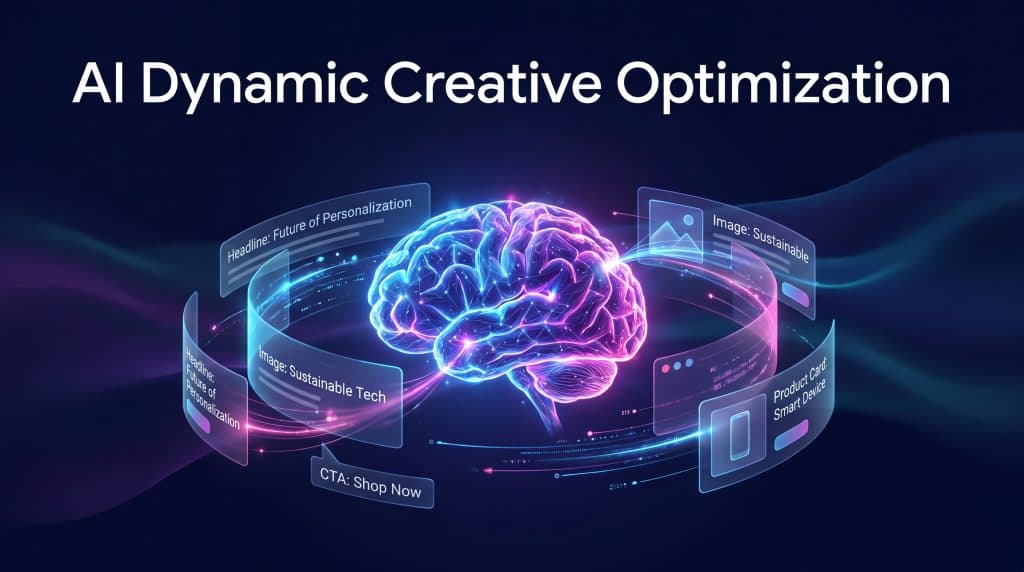
- AI dynamic creative optimization (DCO) breaks an ad into modular parts and rebuilds it in real time for every impression, lifting CTR by 30% and ROAS by 30%+ over static creative.
- The DCO market is on track to top $4 billion globally by 2027, and roughly 40% of digital video ads will be built with generative AI by the end of 2026.
- Real campaigns show the upside: Carrefour saw a 31% ROAS jump while saving 250 manual hours, and a fintech brand cut cost per purchase by 82% inside Meta Advantage+.
- DCO only works when your brand guardrails travel with the creative. Without a brand intelligence layer, AI variations drift off-message fast.
- The winning 2026 stack pairs a production engine, a brand intelligence layer, and a unified analytics view, which is exactly the model MarqOps is built on.
Table of Contents
- What is AI Dynamic Creative Optimization?
- Why DCO Is the Default Mode of Advertising in 2026
- How AI DCO Actually Works Under the Hood
- The Performance Data: What DCO Delivers
- Real Brand Case Studies
- The DCO Tooling Landscape
- The Brand Risk Nobody Talks About
- A 6-Step Playbook to Launch AI DCO This Quarter
- How MarqOps Approaches AI DCO Differently
- FAQs
What is AI Dynamic Creative Optimization?
AI dynamic creative optimization, or DCO, is the practice of assembling display, social, and video ads on the fly using modular creative components and live audience signals. Instead of shipping one polished hero asset and 12 manual variants, your team uploads a library of headlines, images, CTAs, product feeds, and brand rules, and an AI system stitches the right combination together for each impression in milliseconds.
The system reads context such as device, location, weather, time of day, audience segment, browsing history, and where the user is in the funnel, then chooses the version most likely to convert. A first-time visitor in Mumbai sees one creative. A repeat buyer in Singapore sees another. Both ads come from the same source library and the same brand DNA.
This is a structural change in how teams think about creative. Production used to be a sequential factory: brief, shoot, edit, ship, measure. With AI DCO, production becomes a system. You feed the system inputs and rules. It produces and tests thousands of variations against your goals. The work shifts from making one perfect ad to designing the rules that govern many imperfect, hyper-relevant ones. If you have been building this discipline alongside creative automation, DCO is the activation layer that sits on top.
Why DCO Is the Default Mode of Advertising in 2026
Three forces are pushing dynamic creative from a niche tactic into a default expectation. First, the major ad platforms have rebuilt their auctions around AI. Meta Advantage+, Google Performance Max, TikTok Smart+, and Amazon Sponsored TV all reward advertisers who supply more creative variations and let the platform decide what to serve. If you upload three static assets, the platform has nothing to optimize against. If you upload modular DCO inputs, the platform has thousands of effective variants to test.
Second, generative AI has collapsed the cost of producing those variations. About 30% of digital video ads are being built with generative AI today, and media buyers expect that figure to approach 40% by the end of 2026. Over 40% of those buyers say they specifically use genAI to spin up different versions of video ads for different audiences. The marginal cost of a new variant has dropped from hundreds of dollars to cents.
Third, attention is more fragmented than ever. A single buyer touches your brand across mobile feeds, CTV, retail media, search, and AI-powered surfaces in a single afternoon. Static creative cannot keep up. Marketing teams that still operate at the speed of a quarterly creative refresh are losing share to teams that ship a new variant for every meaningful audience segment every week.
Projected DCO market size by 2027 (Statista, eMarketer)
The result is a market projected to clear $4 billion globally by 2027, with the DCO sector growing at roughly 10.2% CAGR through 2033. The teams winning that growth are not the ones with the biggest creative budgets. They are the ones with the cleanest creative systems, often plugged directly into their marketing tech stack and feeding their marketing dashboard in real time.
How AI DCO Actually Works Under the Hood
The technology can sound abstract, so it helps to walk through the actual pipeline. A modern AI DCO stack has five working layers.
1. The Component Library
Your creative team breaks every asset into atomic pieces. A single ad becomes a set of headlines, body copy options, hero images, product shots, logos, CTA labels, background colors, and frame transitions. These pieces are tagged with metadata: which audience they fit, which funnel stage they belong to, which brand rule they comply with.
2. The Brand Intelligence Layer
This is the layer most teams skip and pay for later. Before any AI assembles a variant, it has to know your brand’s rules. Allowed color palettes. Logo clear space. Approved taglines. Tone of voice. Compliance constraints by region. Without this layer, the AI will happily produce a perfectly optimized ad that violates your brand guidelines and your legal review process. We will come back to this in a moment.
3. The Decision Engine
This is where the math happens. The engine ingests live signals from the demand-side platform, the customer data platform, and any first-party sources you connect. It runs a contextual bandit or reinforcement learning model that scores possible creative combinations against the campaign objective. The winning combination is rendered and served.
4. The Production Engine
Once the decision engine picks a recipe, the production engine assembles the final asset. This is where platforms such as Smartly, Hunch, and Celtra live. They render thousands of variants per second, formatted for each placement, with bitrate and aspect ratio optimized for the target inventory.
5. The Analytics Loop
Every served impression flows back into the system with outcome data attached. Did it get a click? A view-through conversion? An add-to-cart? The model retrains on that signal and gets sharper. This is why DCO performance compounds over time, not in spikes. Pair this with strong multi-touch attribution and you can finally see which creative atoms drive revenue, not just clicks.
The mental model that matters: stop thinking of an ad as a deliverable. Start thinking of it as a query against a system that knows your brand, your audience, and your goals. The output is whatever combination scores highest at that moment.
The Performance Data: What DCO Actually Delivers
Performance numbers from 2025 and 2026 are remarkably consistent across the industry. The gains are not subtle and not theoretical.
Marketers adopting DCO report up to 30% lifts in click-through rates and 20% better conversion rates compared to static ads. Industry benchmarks land in a 2x to 5x higher CTR range, 20% to 50% lower CPA, and 30%+ higher ROAS versus static creative. Mobile UA campaigns using automated real-time creative optimization have hit a 58% ROAS increase and a 30% CPA reduction, according to Segwise’s analysis of the category.
The headline number marketing leaders should anchor on: 30%+ higher ROAS and 20% to 50% lower CPA versus static creative, sustained across mobile, social, and CTV inventory.
Platform-specific data tells the same story. Meta Advantage+ campaigns, which sit on top of DCO mechanics, cut CPA by up to 32% in ecommerce and lead gen verticals, with CTR up 11% to 15% from more relevant delivery. Advertisers using AI bidding strategies on Google Ads report 22% lower cost per conversion versus manual CPC. Campaigns that include video assets in their DCO library see 20% to 35% higher reach and 15% to 20% better conversion rates than static-only sets.
The one caveat worth flagging is high-consideration purchases. AI-generated ad variants show 12% higher CTR on Meta across a 50,000+ variation dataset, but conversion rates can drop 8% for high-consideration purchases, widening to 14% for products over $500. The lesson is not to avoid DCO for big-ticket items. It is to feed the system more brand context and longer-funnel signal, not less.
Real Brand Case Studies
The numbers above are aggregate. The proof is in the named campaigns.
Vitapur: Feed-Based DCO on Meta
Vitapur shifted from manual creative production to a feed-based DCO strategy on Meta. The pipeline pulled product data, pricing, and seasonal merchandising signals directly from their commerce backend. Result: 25% ROAS growth and a 47% CTR increase on a media spend that did not change. The unlock was not better creative ideas. It was better creative speed.
Carrefour: Scaled Variation Production
Carrefour automated dynamic creative optimization across thousands of variants spanning store locations, weekly promotions, and category seasonality. The campaign delivered a 31% higher ROAS while saving more than 250 hours of manual creative production work. That is roughly a full-time creative producer’s quarterly bandwidth recovered for higher-leverage work.
Fintech App: Advantage+ With Dynamic Creative
A fintech application layered dynamic creative inside a Meta Advantage+ campaign. ROAS rose 40%. Cost per purchase fell 82%. This is exactly the high-consideration category where AI variants can struggle. The team beat the benchmark by feeding the system rich audience signals and rigorous brand inputs from the start.

AI DCO performance benchmarks across leading platforms (2025-2026)
The DCO Tooling Landscape
The platform market has stratified into three buckets in 2026. Understanding the bucket structure helps you decide what to buy versus what to build.
Production Platforms
These are the workhorses that render thousands of variants per second across formats and placements. Smartly.io leads enterprise-scale production, especially across Google video and display inventory, with deep integrations into product feeds. Hunch sits in the same bracket with a heavier focus on social. Celtra is the long-standing choice for teams that want full control of templates, feeds, and automation rules.
Creative Intelligence Platforms
These layers do not produce ads. They analyze them. Hawky leads here for element-level creative breakdowns, fatigue prediction, and which creative atoms actually drive performance. Segwise plays a similar role with a stronger lens on paid social and mobile UA. The smart play is to pair one of these with a production platform, so you close the loop between what is performing and what is produced.
Unified AI Marketing Operations Platforms
The third bucket is the newest. Platforms like MarqOps that unify creative production, brand intelligence, ad management, SEO, and analytics under one system. Instead of stitching Smartly + Hawky + a separate brand compliance tool + a separate analytics layer + a separate marketing automation tool, the unified platform handles the full loop natively. For most mid-market teams in 2026, this is the most cost-effective path because you stop paying integration tax across five vendors.
If you are still in the comparison phase, our breakdown of AI graphic design generators and AI video generators covers the upstream tooling that feeds the DCO engine.
The Brand Risk Nobody Talks About
Here is the part most DCO vendor decks gloss over. The same AI that gives you 5x CTR can also produce 5x more on-brand mistakes if your brand layer is weak.
Every variation the system generates is a brand surface. If your DCO platform does not know that your logo cannot sit on a busy photo, that your CTA language must be approved by legal in financial categories, or that your accent color shifts in dark mode, you will ship hundreds of subtly off-brand ads before anyone notices. By the time someone does notice, the ads have already been served to millions of impressions.
This is why the brand intelligence layer is the most important investment in a modern DCO stack and the least discussed. It is also why pure production platforms struggle when adopted by marketing teams without a strong brand operating model. The platform amplifies whatever discipline already exists. If the discipline is loose, the platform makes the looseness louder.
Brand intelligence DNA is the unlock. A great DCO program needs guardrails that travel with every variant, every channel, every region. That is the gap MarqOps was built to close, with one source of brand truth feeding every AI variation across creative, ads, and content.
A 6-Step Playbook to Launch AI DCO This Quarter
Here is the practical sequence we see work for marketing teams moving from static creative to AI DCO without setting their brand on fire.
Step 1: Audit Your Current Creative Atoms
Pull every ad you have shipped in the last 12 months. Break each one into headlines, hero shots, CTAs, brand elements, and audience tags. You will end up with a spreadsheet of components. This is your seed library.
Step 2: Codify Your Brand Rules in a Machine-Readable Format
Write down your brand guardrails in a way an AI can consume. Logo placement rules. Approved color hex codes. Tone of voice descriptors. Banned phrases. Region-specific compliance constraints. If you have not done this yet, our brand guidelines template is a fast starting point.
Step 3: Pick One Channel and One Objective to Pilot
Do not roll out DCO across every channel at once. Pick one channel where you already have spend and signal, usually Meta or Performance Max, and one clear objective such as ROAS for ecommerce or CPL for lead gen. Lock the scope before you touch the platform.
Step 4: Build the Production and Brand Stack
Decide between assembling a multi-vendor stack (Smartly + Hawky + a separate brand tool + your existing marketing automation platform) or adopting a unified AI marketing operations platform. For most teams under $50M ARR, unified wins on speed, cost, and brand consistency. For very large advertisers with deep custom needs, multi-vendor often wins.
Step 5: Launch With a Variant Budget, Not a Creative Budget
Reframe your media plan. Instead of approving five creatives for a $50,000 spend, approve a component library and a variant budget. You will ship 500 variants instead of five, and you will discover combinations no human would have manually shipped.
Step 6: Build the Feedback Loop Before You Need It
Wire your DCO output back into your marketing dashboard from day one. Track which creative atoms are driving performance, not just which ad sets are. This is where DCO compounds. Teams that skip this step plateau within a quarter.
How MarqOps Approaches AI DCO Differently
The default DCO model assumes you will bolt three or four tools together. A creative production platform here. A brand compliance tool there. An analytics layer over there. A separate AI copywriting tool to feed the headlines library. Then a project management tool to keep the whole thing coordinated.
MarqOps replaces that 7+ tool stack with one AI-powered marketing operations platform. The same brand intelligence DNA that governs your SEO content also governs your DCO variants, your social posts, and your paid creative. The same dashboard that tracks your campaign performance also surfaces creative fatigue and brand drift. Marketing teams ship up to 6x faster because the integration work and the brand reconciliation work disappear into the platform.
This matters most for the brand risk problem we covered above. A unified system means there is one place to update brand rules, and those rules instantly propagate to every variant the system generates. No more guardrails living in five tools and drifting out of sync.
Frequently Asked Questions
What is the difference between AI dynamic creative optimization and traditional A/B testing?
A/B testing pits two finished creatives against each other and waits for statistical significance. DCO operates on a different scale: it assembles thousands of variants in real time and uses contextual bandits or reinforcement learning to decide which combination to serve to each user. A/B testing is a controlled experiment. DCO is an always-on optimization loop that learns continuously.
How much creative budget do I need to start with AI DCO?
You do not need a bigger budget. You need a different budget. Instead of paying for five hero assets, pay for a component library: 20 to 50 headlines, 10 to 20 image variants, 5 to 10 CTA versions, and clean brand rules. The same dollar spend that bought five static ads can fuel thousands of dynamic variants once the system is in place.
Does AI DCO work for B2B or just for ecommerce?
It works for both, but the playbook differs. Ecommerce DCO leans heavily on product feeds and price signals. B2B DCO leans on account-based signals, funnel stage, and intent data. Our guide on B2B marketing automation covers how to wire DCO into a longer-cycle pipeline. The performance lifts are smaller in absolute CPA terms but often larger in pipeline efficiency.
What is the biggest mistake teams make when launching AI DCO?
Skipping the brand intelligence layer. Teams plug in a production platform, ship 1,000 variants in week one, and discover that 200 of them violate brand or compliance rules. By then the off-brand ads have already been served to real audiences. The fix is to codify brand rules in a machine-readable format before you generate a single variant.
How does MarqOps fit into a DCO workflow?
MarqOps unifies the production engine, the brand intelligence layer, and the analytics loop in a single platform. Instead of buying Smartly, Hawky, a brand compliance tool, and a separate dashboard, you operate the full DCO stack inside one system. The brand DNA you set up for your AI content strategy also governs your DCO variants, which keeps every channel consistent without manual reconciliation.