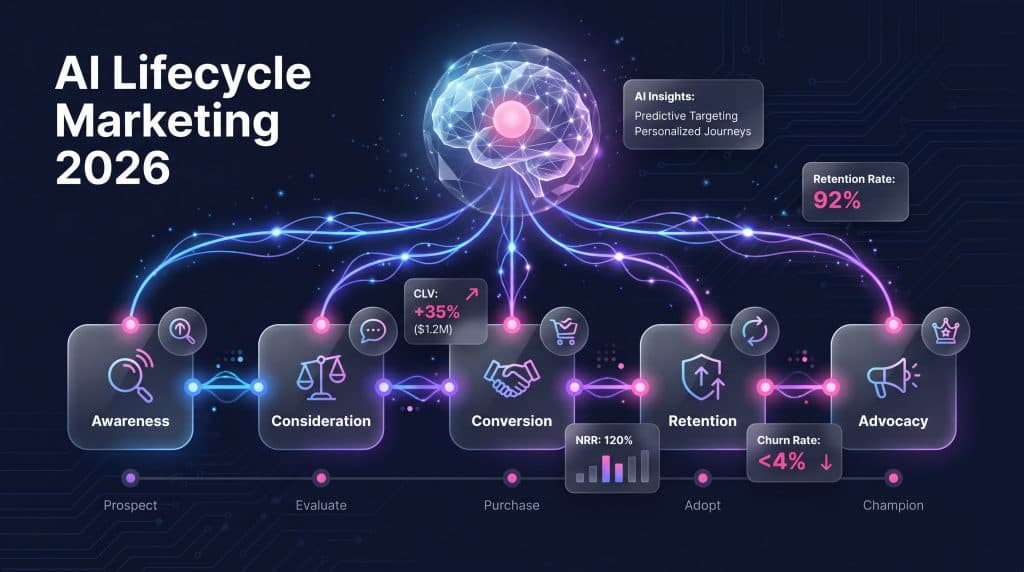
Acquisition costs have climbed 222% in the last eight years. Retaining an existing customer still costs five to seven times less than winning a new one. And companies using predictive retention models post 20% higher Net Revenue Retention than teams stuck in reactive mode. In 2026, the marketing teams winning that math are not the ones with the biggest budgets. They are the ones running a single, AI-driven lifecycle from the first impression all the way through to the loyalty program renewal.
This guide breaks down how AI lifecycle marketing works in 2026, the five stages every modern team needs to operate, the agentic shift moving from copilot to autonomous execution, the platforms worth evaluating, and a 90 day rollout plan that ties it all back to revenue. If your stack is still split across seven tools and your retention motion is an afterthought, this is the playbook.
TL;DR
- AI lifecycle marketing connects every customer stage (awareness, consideration, conversion, retention, advocacy) into one continuously optimizing system instead of disconnected campaigns.
- The 2026 shift is from rule based automation to agentic AI that reads live signals, decides next-best action, and executes across channels without waiting for a human prompt.
- Retention now drives 70% of long term value. A 5% retention lift can grow profits 25 to 95%, and omnichannel customers carry 30% higher CLV.
- Most teams still operate seven or more disconnected tools across the lifecycle. The winners in 2026 consolidate onto unified platforms with brand intelligence built in.
- MarqOps gives marketing teams one platform that runs the full lifecycle: AI content for awareness, predictive segments for consideration, real-time offers for conversion, churn prevention for retention, and brand-perfect advocacy assets.
Table of Contents
- What Is AI Lifecycle Marketing in 2026?
- Why AI Lifecycle Marketing Matters Now
- The Five Stages of AI Lifecycle Marketing
- The Agentic Shift: From Copilot to Autonomous Execution
- The Modern AI Lifecycle Marketing Tech Stack
- Platforms Compared: Braze, Iterable, Klaviyo, and the Unified Option
- The Metrics That Actually Matter
- A 90 Day Rollout Plan for Marketing Teams
- Common Mistakes to Avoid
- How MarqOps Unifies the Full Lifecycle
- FAQs
What Is AI Lifecycle Marketing in 2026?
AI lifecycle marketing is the practice of using artificial intelligence to plan, execute, and continuously optimize every customer interaction across the full customer lifecycle, from the first ad impression through to long term loyalty. It treats the customer journey as one connected system rather than a series of isolated campaigns owned by different teams and powered by different tools.
Traditional lifecycle marketing relied on if-this-then-that workflows. Someone abandons a cart, fire an email two hours later. A subscription is about to renew, send a reminder fourteen days out. These rules still work for simple flows. But they break down the moment a customer behaves in any way that was not pre-mapped in a flowchart. AI changes that. Instead of executing pre-built rules, AI systems learn from every interaction, predict what the next best action should be, and personalize the message, channel, timing, and offer for each individual.
The global AI marketing market reached $47.32 billion in 2026 and is projected to climb to $107.5 billion by 2028, growing at a compound annual rate of 36.6%. That growth is concentrated in lifecycle use cases because that is where the math is sharpest: every percentage point of retention lift compounds, and AI is now reliable enough to make those calls at scale.
Why AI Lifecycle Marketing Matters Now
Three forces are forcing the move in 2026:
1. The Economics of Acquisition Have Broken
Customer acquisition costs are up 222% in eight years. Paid social CPMs keep climbing. Cookie deprecation took a chainsaw to retargeting accuracy. The math no longer works if you are spending more to acquire customers than you can earn back in the first two years. That has pushed lifecycle, retention, and expansion from “nice to have” into the highest leverage growth activity on the planet.
Profit lift from a 5% increase in customer retention
2. Customer Expectations Are Personal, Real-Time, and Cross-Channel
Customers in 2026 expect the brand they bought from on Instagram to recognize them when they open the email tomorrow, the SMS on Friday, and the website on Sunday. They expect the offer to be relevant to what they just looked at, not the campaign that someone scheduled three weeks ago. Rule based automation cannot keep pace. AI can, because it can pull from the full behavioral history in real time and decide what to do next without a human in the loop.
3. Agentic AI Made the Stack Possible
For years, “AI in marketing” mostly meant predictive scoring buried inside an email tool. In 2026, agentic AI systems can actually take action: write the message, choose the channel, set the send time, build the audience, push the campaign live, monitor performance, and adjust the next iteration. That makes lifecycle execution at scale a software problem instead of a headcount problem.
The Five Stages of AI Lifecycle Marketing
Most modern frameworks share five stages. The names vary, but the customer journey does not.

The 5 stages of AI lifecycle marketing, from awareness through advocacy.
Stage 1: Awareness
This is the discovery stage. A potential customer has a problem and starts looking for solutions. The job here is to be findable and credible. AI tools generate SEO content at scale, optimize for both traditional search and AI overviews, run programmatic ads with predictive targeting, and produce social content that adapts to platform-specific patterns. The teams that win here treat content production as a continuous pipeline, not a quarterly project. For a deep dive on how that pipeline works, see our guide to AI content strategy.
Stage 2: Consideration
The prospect knows you exist and is now comparing options. AI helps by building predictive segments that combine behavioral signals (pages viewed, content downloaded, time spent) with firmographic data, then triggering the right nurture sequence. AI driven personalization replaces the old “blast everyone in segment B” approach with one-to-one journeys that feel hand crafted. The deeper layer here is AI customer segmentation that self-updates as behavior changes, so the segment a buyer is in today is not necessarily the one they belong to tomorrow.
Stage 3: Conversion
This is the moment of truth. AI shines here through real time decisioning: which offer, which channel, which message, which incentive will actually move this specific person across the line. Dynamic creative optimization stitches together the right combination of headline, image, and call to action in milliseconds. AI driven lead scoring tells sales which leads to call first. For the conversion side of the funnel specifically, our breakdown of the AI marketing funnel walks through the stage-by-stage AI mapping.
Stage 4: Retention
Retention is where lifecycle marketing earns its keep. The patterns are well known: onboarding, activation, second purchase, expansion, renewal. AI changes how each one runs. Predictive churn models flag at-risk accounts weeks before they actually leave, then trigger save campaigns automatically. Recommendation engines surface the right upsell at the right moment. Usage-based nudges keep customers engaged with the features they have not adopted yet. Our customer churn prediction guide covers the modeling side in depth.
The retention dividend: Companies using predictive retention models post 20% higher Net Revenue Retention. The highest projected lifecycle ROI (300%) comes from the Expansion stage, which retention makes possible.
Stage 5: Advocacy
Loyal customers become a growth channel. AI identifies who is most likely to refer, surfaces the moment they are happiest (post-renewal, post-success milestone), and personalizes the referral or review ask. Loyalty programs run dynamically instead of as flat tier systems. Community engagement gets the same attention as paid acquisition because it costs a fraction and converts at a multiple.
The Agentic Shift: From Copilot to Autonomous Execution
The biggest change in 2026 is the move from AI copilot to AI agent. A copilot suggests. An agent does. The Marketing Automation Maturity Model now goes through five stages: Ad-Hoc, Foundational, Integrated, Predictive, and finally Agentic, where execution is handed to agents that read live signals, optimize autonomously, and bring humans in by exception with full audit trails.
In practice that means an agent assigned to “minimize churn for the SMB segment” will pull the live churn-risk scores, identify the top 200 at-risk accounts, write a personalized re-engagement message for each one, route it through the channel that has historically worked best for that customer, monitor opens and replies, and either escalate to a CSM or schedule a follow up depending on the response. None of those steps required a marketer to push a button.
The implications are significant. Headcount becomes less of a constraint on volume. Speed becomes a function of agent reasoning quality, not approval queues. And the role of the lifecycle marketer shifts from operator to designer, setting the goals, guardrails, and brand standards that the agents work within. We covered the broader pattern in our piece on AI agents for marketing.
The Modern AI Lifecycle Marketing Tech Stack
A working AI lifecycle stack in 2026 has four layers:
1. Unified Data Layer. A real time customer data platform that consolidates first party data, behavioral signals, transaction history, and product usage into one identity. Without this layer, AI is working with partial information. See our deep dive on the AI customer data platform.
2. AI Decisioning Engine. The brain that runs predictive models for segmentation, propensity scoring, churn risk, next best action, and offer optimization. This is where agentic execution lives.
3. Channel Orchestration. Email, SMS, push, in-app, paid media, web personalization, and direct mail, all firing off the same decisioning layer so the customer sees a coherent journey across surfaces. Customer journey orchestration covers the orchestration mechanics in detail.
4. Measurement and Attribution. Closed loop measurement that ties every touchpoint to revenue impact using marketing mix modeling, multi-touch attribution, and incrementality testing combined. This is the feedback loop that lets the AI keep improving.
The hidden cost of fragmentation: The average mid-market marketing team in 2026 runs 7 to 12 disconnected tools across the lifecycle. Every handoff between them is a place where data goes stale, brand voice drifts, and AI loses the context it needs to make good decisions. Consolidation is not just a cost play. It is a quality play.
Platforms Compared: Braze, Iterable, Klaviyo, and the Unified Option
The market has consolidated around a few patterns. Here is how the major lifecycle platforms stack up in 2026:
Braze wins on enterprise scale orchestration. Cross-channel decisioning, real time triggers, advanced audience management. Pricing lands in the mid five to six figures annually.
Klaviyo wins on e-commerce specific predictive analytics and rapid time to value. Strong on email and SMS, lighter on cross-channel. Best for D2C and Shopify-heavy stacks.
Iterable sits between the two, with strong cross-channel orchestration and flexible data integration at enterprise pricing.
Customer.io and MoEngage compete on developer-friendly orchestration and mobile-first engagement respectively.
All of these solve the lifecycle execution problem well. None of them solve the broader marketing operations problem, which is that lifecycle execution sits inside a larger workflow that also includes content production, SEO, paid media, creative production, and analytics. That is where unified platforms like MarqOps fit, replacing seven or more disconnected tools with one brand-aware system that runs across the full marketing function, not just the engagement layer.
The Metrics That Actually Matter
If you are setting up an AI lifecycle program, these are the numbers to track from day one:
Customer Lifetime Value (CLV). The north star. Personalization leaders generate 40% more revenue from personalization than average players, and omnichannel customers have 30% higher CLV.
Net Revenue Retention (NRR). The SaaS standard for measuring whether your existing book of business is growing or shrinking. Predictive retention models drive 20% higher NRR.
Repeat Purchase Rate. For e-commerce, this collapses fast: 52% by month 3, 28% by month 12. The job of lifecycle marketing is to flatten that curve.
LTV:CAC Ratio. Cross-industry median sits at 3.4 in 2026. Top quartile is 5.6 and pulling away. The teams in the top quartile are the ones running tight lifecycle operations.
Time to Activation. The lag between sign up and the first valuable action. AI driven onboarding can cut this by 30 to 50% by personalizing the path.
Churn Rate by Cohort. Watch churn at the cohort level, not the aggregate. Aggregate churn hides the rot. For a deeper measurement framework, see our AI marketing ROI guide.
A 90 Day Rollout Plan for Marketing Teams
Most lifecycle programs fail because teams try to boil the ocean. A pragmatic 90 day plan:
Days 1 to 30: Foundation
Audit the current stack. Identify every tool that touches a lifecycle stage, document the data sources, and find the gaps. Consolidate identity into one source of truth. Define your North Star metric (usually CLV or NRR) and the inputs that drive it. Pick one lifecycle stage to fix first. Retention is usually the right answer because the leverage is highest.
Days 31 to 60: First AI Use Case Live
Stand up one AI driven workflow end to end. Recommended: predictive churn scoring feeding an automated save campaign. Set a clear baseline, run the workflow for at least four weeks, and measure incremental retention against a holdout. This is your proof of concept and the template you will repeat.
Days 61 to 90: Expand and Orchestrate
Layer in the next two use cases. Common picks: AI personalization for the consideration stage, and AI driven cross-sell at the renewal moment. Connect them through the unified decisioning layer so they share signals rather than firing independently. Establish a weekly review rhythm that looks at the lifecycle metrics, not just channel metrics. Tie agent goals to those metrics.
What to skip in the first 90 days: Full re-platforming, big bang launches, and any AI initiative that requires more than one engineer to set up. Speed of learning beats scope of plan.
Common Mistakes to Avoid
Confusing automation with orchestration. Sending a welcome email after sign up is automation. Coordinating welcome email, in-app onboarding nudge, retargeting suppression, and CSM hand-off based on real-time behavior is orchestration. Most teams stop at automation and call it lifecycle.
Ignoring brand consistency. AI generates volume. Without a brand intelligence layer, that volume drifts off-brand fast. MarqOps approaches this with Brand Intelligence DNA that every AI generated asset inherits, so the AI is producing brand-perfect output from the first run.
Measuring channel performance instead of lifecycle performance. Email open rate is a vanity metric if you do not know what stage of the lifecycle that email touched. Tie every metric back to a lifecycle stage and the North Star.
Treating retention as an afterthought. Most marketing teams still allocate 70% of budget to acquisition. The math no longer supports that. Rebalance toward retention and expansion.
Buying seven tools to do one job. Tool sprawl is the single biggest source of friction in modern lifecycle programs. Every handoff between tools is a place where context is lost. See marketing tech stack for the consolidation playbook.
How MarqOps Unifies the Full Lifecycle
MarqOps is built for the exact problem AI lifecycle marketing creates: too many tools, too many handoffs, brand voice drifting between systems, and no single AI brain that sees the whole customer. One platform handles content production for the awareness stage, predictive segmentation for consideration, real-time offer decisioning for conversion, churn prevention and expansion plays for retention, and brand-perfect creative for advocacy. The Brand Intelligence DNA layer means every AI output, whether it is an SEO article, a paid social ad, or a re-engagement email, sounds like the brand from the first draft.
Teams using MarqOps replace seven or more disconnected tools with one unified dashboard, ship content six times faster, and run lifecycle programs without needing a developer to wire up integrations between point solutions. Enterprise security with SOC 2 compliance and GDPR readiness is built in, and the multi-model AI pipeline picks the best model for each job rather than locking you into one vendor.
Frequently Asked Questions
What is the difference between lifecycle marketing and AI lifecycle marketing?
Lifecycle marketing is the strategy of engaging customers across every stage of their journey with the brand. AI lifecycle marketing applies machine learning and agentic AI to that strategy, replacing rule-based workflows with predictive and autonomous systems that personalize each interaction in real time. The strategy is the same. The execution is faster, smarter, and works at a scale rules cannot match.
How is AI lifecycle marketing different from customer journey orchestration?
Customer journey orchestration is one component of AI lifecycle marketing. Orchestration handles the real-time coordination of channels and touchpoints once a customer is in motion. Lifecycle marketing is the broader strategy that defines the stages, goals, and metrics that orchestration optimizes against. You need both, and the best results come from running them on the same data and decisioning layer.
Which stage of the lifecycle has the highest ROI for AI investment?
Retention. The projected ROI for the expansion stage hits 300% and effective retention drives 250%. Acquisition typically returns less because the cost of acquiring new customers is up 222% in eight years while retention costs have stayed relatively flat. Start your AI investment with predictive churn and expansion use cases.
Do I need a customer data platform to run AI lifecycle marketing?
Yes, in practice. AI is only as good as the data it can see. A unified customer view that combines behavioral, transactional, and engagement data is the foundation. Without it, predictions are partial and recommendations miss obvious patterns. Modern platforms like MarqOps include the CDP layer so teams do not have to assemble it separately.
How long does it take to see results from AI lifecycle marketing?
Most teams see measurable lift on the first use case within 60 to 90 days, especially when starting with retention or onboarding. Full lifecycle programs take 6 to 12 months to reach steady state. The fastest wins come from automating something that was previously manual or rule-based, not from inventing new programs from scratch.
Can a small marketing team run AI lifecycle marketing without a dedicated ops person?
Yes, and that is exactly the shift unified platforms enable. The need for a dedicated ops person typically comes from integration overhead between tools. When the data, decisioning, and channel layers live in one platform, a generalist marketer can run programs that previously required a multi-person team.
What about brand voice consistency when AI is generating thousands of messages?
This is the biggest risk in scaling AI lifecycle output, and it is solved by codifying brand voice as a constraint the AI works within rather than something a human has to police on every output. MarqOps uses a Brand Intelligence DNA layer that every generated asset inherits, so brand consistency is baked into the AI from the first draft.
Putting It Into Practice
AI lifecycle marketing is not a tactic or a campaign type. It is the operating model marketing teams will run on for the next decade. The teams that consolidate their stack, put a unified AI brain in front of the customer, and treat retention as the highest leverage activity in the business are the teams that will compound year over year while their competitors keep buying more ads at higher prices.
If your stack today is seven tools and your retention motion is a quarterly newsletter, the next 90 days are the right time to fix it. Start with one use case, prove the math, and expand from there.