
AI Marketing Assistant in 2026: How Smart Teams Replace 7 Tools With One Brand-Aware Brain
TL;DR
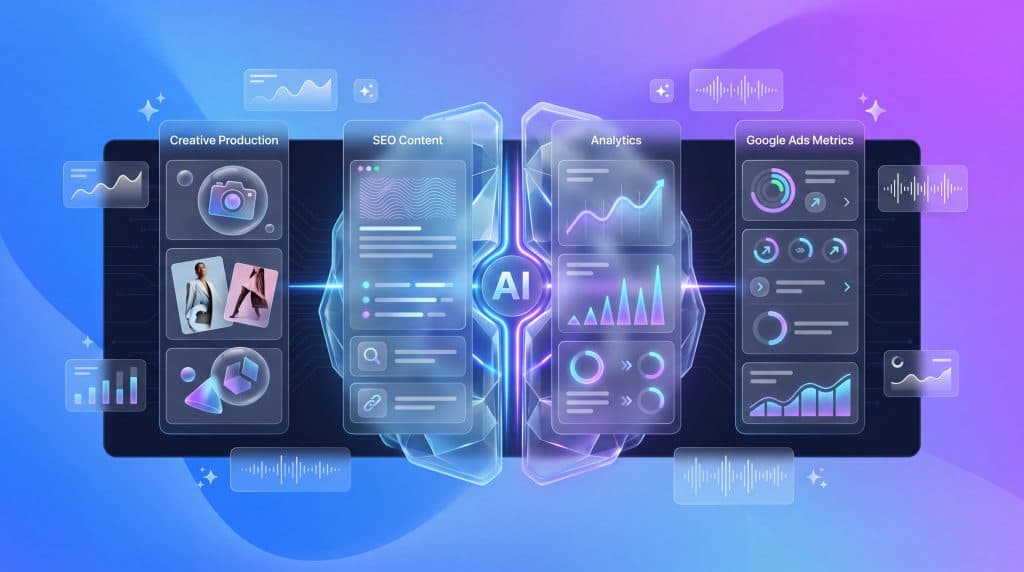
An AI marketing assistant is no longer a chatbot that drafts emails. In 2026 it is an agentic system that runs campaigns, writes on-brand copy, optimizes ads, and answers analytics questions in natural language. Teams using one save 11-13 hours per week, ship content 6x faster, and report 22% higher campaign ROI. The best modern setups consolidate creative, SEO, analytics, and ads into a single brand-aware platform instead of stitching together seven point tools. This guide shows you what an AI marketing assistant actually does, the use cases that move pipeline, how to evaluate vendors, and how MarqOps fits as a unified option for marketing teams ready to ditch tab-switching for good.
Table of contents
- What is an AI marketing assistant?
- From chatbot to agent: the 2026 shift
- 10 use cases that actually move pipeline
- Adoption and ROI: the numbers
- Features that separate winners from toys
- How MarqOps compares to point tools
- How to roll one out in 30 days
- 5 mistakes that kill ROI
- What is coming next
- FAQs
What is an AI marketing assistant?
An AI marketing assistant is software that uses large language models, image models, and analytics engines to plan, execute, and optimize marketing work that a human used to do manually. Think of it as a junior marketer who never sleeps, knows your brand guidelines by heart, and can handle copy, creative, campaign analysis, and reporting on demand.
The category has matured fast. Two years ago, an AI marketing assistant meant a ChatGPT tab open in another window. Today, it means a system embedded in your workflow that connects to your CRM, your ad accounts, your CMS, and your analytics, then takes multi-step actions on its own. The best ones do not just answer questions. They plan a campaign, draft the creative, schedule the launch, watch the data, and tell you what to change next.
If you already use tools like an AI copywriting tool, an AI marketing automation platform, or AI agents for marketing, you are already touching pieces of an assistant. The 2026 question is whether you keep them as seven separate tools or collapse them into one.
From chatbot to agent: the 2026 shift
The defining shift this year is the move from prompt-driven assistance to agentic automation. According to recent research from McKinsey and OneReach, 45% of marketing teams report using at least one agentic AI system in 2026, up from just 15% in 2024. Enterprise teams have moved even faster, with 34% running at least one autonomous agent in production, up from 14% in Q4 2025.
Three things changed to make this real:
- Model quality crossed the threshold. Claude Opus 4.6, Gemini 3 Pro, and GPT-5 now reason well enough to handle multi-step plans without falling over. Outputs that needed heavy editing in 2024 ship as-is.
- Tool use became standard. Models can now call CRMs, ad platforms, CMSs, and databases through Model Context Protocol (MCP) and similar standards. The assistant is no longer trapped behind a chat box.
- Brand intelligence got serious. Modern platforms ingest your visual identity, voice, and audience data so outputs are on-brand from the first try, not the fifth. This is the core idea behind a strong AI brand voice system.
10 use cases that actually move pipeline
Marketers love demos. CMOs care about outcomes. Here are the use cases an AI marketing assistant handles today that produce measurable pipeline lift, not just productivity theater.
1. Multi-channel campaign generation
Brief the assistant on a campaign goal and audience. It returns a launch plan, channel mix, copy variants, image creative, landing page copy, and an email sequence, all on-brand. Teams using assistants for full campaigns report launching them 10 to 15 times faster than before, according to McKinsey research.
2. On-brand creative production
Upload your brand guide once. The assistant generates images, video frames, and ad creatives that respect your colors, fonts, and visual rules. This pairs naturally with a creative automation workflow that produces hundreds of variants without losing brand consistency.
3. SEO content at scale
Modern assistants pull live SERP data, competitor analysis, and keyword volumes, then draft long-form content with internal links and FAQ schema. The MarqOps SEO Ops pillar runs an 8-step research-to-publish pipeline and ships 5,000 to 8,000 word articles directly to WordPress.
4. Paid media optimization
Connect Google Ads and Meta. The assistant flags wasted spend, recommends keyword pauses, suggests negative keywords, and writes new ad copy variants. The traffic light keyword analysis built into MarqOps Ad Ops typically saves teams hundreds of dollars per month in wasted PPC spend.
5. Analytics in plain English
Ask “which campaigns drove the most conversions last month?” The assistant queries GA4, GSC, and your ad platforms, then answers in plain English with the chart attached. A strong AI marketing analytics layer turns dashboards into conversations.
6. Personalization at the segment level
The assistant identifies high-value segments using behavioral signals, then writes versioned messaging for each. Real deployments show 3 to 5x higher email click-through rates from individualized personalization.
7. Lead scoring and routing
Score inbound leads against your ICP using firmographic and engagement signals, then route to the right rep with talking points pre-loaded. Teams report 20 to 30% improvement in cost-per-pipeline from continuous AI-driven optimization.
8. Customer journey orchestration
The assistant identifies at-risk customers, picks the right channel and message, launches the intervention, and measures results, all without a human building the workflow each cycle.
9. Reporting automation
Weekly and monthly performance reports build themselves. The assistant pulls data, writes the narrative, calls out anomalies, and ships the deck to stakeholders. One survey found marketing teams save 2.5 hours per day on reporting and content tasks with AI.
10. Competitive intelligence
The assistant tracks competitor ads, content, and pricing changes, then summarizes what changed and what to do about it. This is rapidly becoming table stakes for any serious AI marketing strategy.
See an AI marketing assistant built for ops, not chat
MarqOps unifies creative, SEO, analytics, and ads under one brand-aware AI. No tab-switching, no seven subscriptions.
Start Free – No Card Required See How MarqOps WorksAdoption and ROI: the numbers
If you are pitching an AI marketing assistant to a skeptical CFO, these are the numbers worth memorizing. They come from research by Adobe, McKinsey, OneReach, HubSpot, and the Marketing AI Institute.
One nuance worth noting: only 41% of marketers can confidently point to improved ROI from their AI efforts. The gap between “we save time” and “we make more money” is the difference between a productivity simulation and a real business transformation. The next two sections explain how to land on the right side of that line.

Source: aggregated research from Adobe, McKinsey, OneReach, HubSpot, MarketingBrew (2025-2026)
Features that separate winners from toys
Not every product that calls itself an AI marketing assistant qualifies. Here is the feature checklist that real ops teams use when evaluating one.
Brand Intelligence DNA
The assistant must understand your brand before it generates anything. That means ingesting your colors, fonts, logo rules, voice guidelines, target personas, and competitive context. Without this, every output needs human cleanup. With it, outputs are brand-perfect from the first try. MarqOps maps your brand across 9 categories in under two minutes from a website URL.
Multi-model AI pipeline
No single model is best at everything. A modern assistant routes copy tasks to Claude Opus or GPT-5, image generation to Flux Pro or Imagen 3, video to Veo 3.1, and research to Perplexity Sonar. You get the best output for each task without managing six vendor contracts.
Native integrations
It must connect to the systems you already use: Google Ads, GA4, GSC, WordPress, your CRM, your email platform. One-click OAuth, not 40 hours of integration work. Tools that live behind chat-only interfaces become orphaned within six months.
Agentic workflows
The assistant must take action, not just answer. That means scheduled pipelines, multi-step workflows, and the ability to write back into your systems, not just read from them. This pairs with a strong marketing workflow automation setup.
Enterprise security
SOC 2 compliance, GDPR readiness, row-level security on customer data, and clear data residency rules. Your marketing data is some of your most sensitive. Treat it that way.
Natural-language analytics
You should be able to ask “which keyword campaigns are wasting budget?” and get a real answer pulled from your live data, not a generic AI guess. RAG-powered chatbots with source attribution are the new bar.
How MarqOps compares to point tools
The market splits into two camps: single-purpose assistants (Klaviyo’s K:AI for ecommerce email, HubSpot’s content assistant for blogs, Jasper for copy) and unified ops platforms like MarqOps. The trade-off is depth in one channel versus coverage across all of them.
| Capability | Single-purpose tools | MarqOps unified platform |
|---|---|---|
| Channels covered | 1 to 2 (e.g., email or copy) | Creative, SEO, Analytics, Ads |
| Brand consistency | Manual cleanup needed | Brand Intelligence DNA enforced |
| Tool sprawl | 6 to 8 subscriptions | One platform, one bill |
| AI models | 1 model per tool | 6+ models routed automatically |
| Monthly cost | $500+ across the stack | $0 free tier, scales with usage |
| Time to first output | Weeks of setup | Under 2 minutes |
| Analytics access | Per-tool dashboards | Unified RAG chatbot |
For ecommerce-only teams that live in email, Klaviyo’s K:AI is excellent. For content-only teams that publish 20 blogs a year, HubSpot’s content assistant covers the basics. But marketing ops leaders running creative, SEO, paid, and analytics in parallel typically find the unified approach reduces total cost and eliminates the integration tax that kills time savings on point tools.
How to roll one out in 30 days
A successful rollout is not about the tool. It is about the workflow change. Here is the 30-day playbook that mid-market teams use to ship measurable wins.
Week 1: Brand setup and audit
Upload your brand guidelines, logos, color palette, and voice rules. Run the assistant against your last 10 pieces of content and measure the gap between what it produces and what shipped. The gap shows you where the productivity wins are.
Week 2: Pick one workflow to migrate
Do not try to migrate every workflow at once. Pick the highest-volume, lowest-creative-risk task. For most teams, that is blog content production or weekly performance reporting. Win there first.
Week 3: Wire integrations and run in parallel
Connect Google Ads, GA4, GSC, and your CMS. Run the AI workflow side by side with your old process for one week. Track hours saved, output quality, and any brand violations.
Week 4: Cut over and measure
Move the workflow to AI-first. Keep human approval in the loop for the first month, then move to spot-check after. Report hours saved, output volume, and any business metrics (traffic, conversions, pipeline) week over week.
Mid-market teams following this playbook typically hit 76% automation success within the first year, mirroring the broader benchmark from the Marketing AI Institute.
5 mistakes that kill ROI
The teams that fail with AI marketing assistants almost always make the same five mistakes. Avoid them.
1. Skipping the brand setup
If you do not upload brand guidelines, every output will need editing. You will conclude AI is “not ready.” It is. You skipped the setup.
2. Picking the wrong first workflow
Do not start with brand campaign creative, where mistakes hurt most. Start with blog drafts, weekly reports, or social copy where the cost of a re-write is low.
3. Buying seven tools instead of one
The cost is not the subscriptions. The cost is the integration tax, the context switching, and the lost insights that never travel between tools. A unified marketing operations platform avoids this.
4. Treating it as a chat tool
If you are still copy-pasting prompts into a chat window, you have not deployed an assistant. You have a fancier search box. Real assistants run workflows on schedule, integrate with your stack, and write back into your systems.
5. Skipping the human-in-the-loop phase
Move to full autonomy too fast and one bad output hits production. Keep human approval for the first 30 days. Most teams move to spot-check after, not full removal.
What is coming next
Three trends are reshaping the AI marketing assistant category through the rest of 2026 and into 2027.
Voice-first assistants. Marketers will increasingly run their assistants from voice interfaces during commutes and between meetings. Expect “show me yesterday’s spend” to replace dashboard logins.
Cross-org agents. Marketing assistants will coordinate with sales and product assistants automatically, sharing lead context, product launches, and customer signals without a human standup in the middle.
Brand-aware multi-agent systems. Instead of one assistant doing everything, you will run a team of specialized agents (creative agent, SEO agent, ad agent, analytics agent) coordinated by a brand-aware supervisor. MarqOps is already building toward this architecture.
The companies that win the next two years will not be the ones with the best AI model. They will be the ones who reorganized their marketing function around brand-aware AI assistants and rebuilt their workflows accordingly.
FAQs
What is an AI marketing assistant in 2026?
An AI marketing assistant is an agentic software system that plans, executes, and optimizes marketing tasks across creative, SEO, analytics, and paid media. Unlike a chatbot, it integrates with your stack and takes multi-step actions on its own.
How much time does an AI marketing assistant save?
Marketers recover 11 to 13 hours per week on average, with senior practitioners saving 8 to 10 hours and junior staff 3 to 4. Teams using AI for full content production loops ship 6x faster.
Is an AI marketing assistant better than a single-purpose tool?
It depends on the team. Single-purpose tools (like Klaviyo for ecommerce email or Jasper for copy) win on depth in one channel. Unified platforms like MarqOps win for marketing ops teams running creative, SEO, paid, and analytics in parallel because they eliminate the integration tax and brand inconsistency that comes with tool sprawl.
How do I measure ROI on an AI marketing assistant?
Track three dimensions: time saved (hours per week), output quality (brand consistency, error rate), and revenue lift (pipeline, conversions, customer LTV). The trap is reporting only time saved. Productivity that does not translate to pipeline is a productivity simulation, not transformation.
What are the best AI marketing assistant tools in 2026?
For unified marketing operations, MarqOps. For ecommerce-only email, Klaviyo K:AI. For HubSpot-native teams, HubSpot Breeze. For content-only workflows, Jasper or Copy.ai. The best choice depends on whether you need depth in one channel or coverage across all of them.
Can an AI marketing assistant run paid ad campaigns?
Yes. Modern assistants integrate with Google Ads and Meta to flag wasted spend, recommend keyword pauses, and write ad copy variants. MarqOps Ad Ops uses a traffic light keyword analysis system that typically saves teams hundreds per month in wasted PPC spend.
Is my data safe in an AI marketing assistant?
Look for SOC 2 compliance, GDPR readiness, row-level security, and clear data residency rules. MarqOps is SOC 2 compliant with GDPR-ready data handling and row-level security on all marketing data.
How long does it take to deploy an AI marketing assistant?
The 30-day playbook works for most mid-market teams: Week 1 for brand setup, Week 2 to pick a workflow, Week 3 to wire integrations and run in parallel, Week 4 to cut over and measure. Setup time on MarqOps itself is under two minutes.
Ready to replace seven tools with one brand-aware AI?
MarqOps unifies Creative Ops, SEO Ops, Analytics Ops, and Ad Ops under one platform. Setup in under two minutes. Free forever tier.
Start Free – No Card Required See How MarqOps WorksLooking for related reads? See our guides on AI agents for marketing, AI in marketing automation, AI marketing strategy, AI personalization, and the best AI marketing tools in 2026.