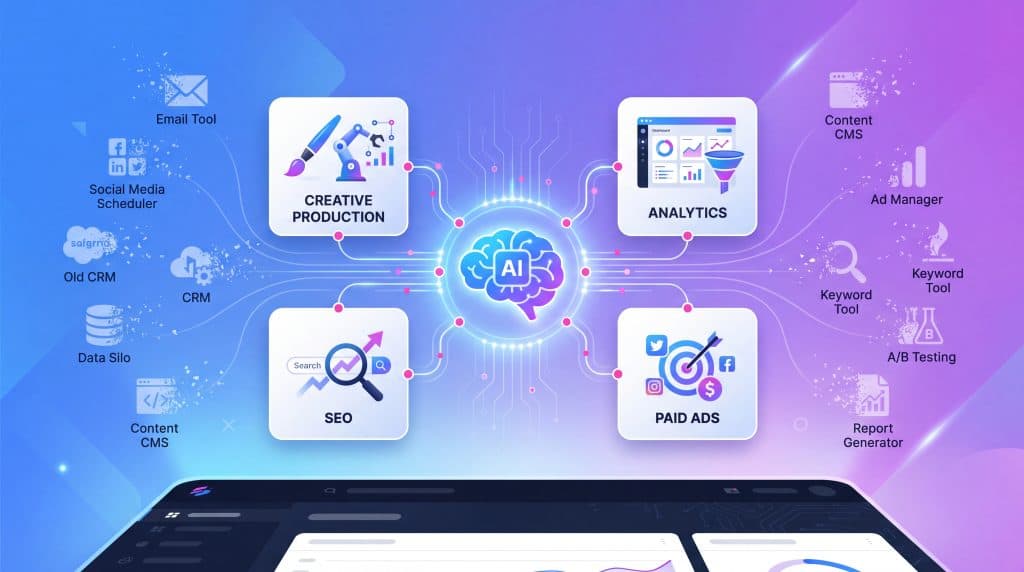
AI-Powered Marketing Platforms in 2026: How One Unified Stack Replaces 7+ Disconnected Tools
Last updated: May 2026 | 12 min read | By the MarqOps team
TL;DR
AI-powered marketing platforms consolidate creative production, SEO, paid ads, and analytics into a single brand-aware system. The shift matters because the 2026 MarTech Landscape grew just 0.7% year over year as buyers ditched bloated stacks. Marketing teams running 5 or fewer core tools generate roughly 23% more attributed pipeline per headcount than teams running 25+. The top AI marketing platforms in 2026 fall into four buckets: full-stack platforms (MarqOps, HubSpot, Salesforce Einstein), customer engagement platforms (Optimove, Drift), analytics-led platforms (Adobe Analytics, Cometly), and autonomous campaign platforms (Albert.ai, Optimizely). The right choice depends on your data maturity, team size, and how much workflow consolidation you actually want.
Table of Contents
- What is an AI-powered marketing platform?
- Why 2026 is the consolidation year
- The 4 categories of AI marketing platforms
- Top AI-powered marketing platforms in 2026
- 9 capabilities every AI marketing platform should ship with
- How to choose the right AI marketing platform
- A 90-day implementation playbook
- 5 pitfalls that kill AI marketing platform ROI
- What’s next: agentic marketing and brand intelligence
- Frequently asked questions
What is an AI-powered marketing platform?
An AI-powered marketing platform is a single system that uses machine learning, generative AI, and predictive models to run multiple marketing functions, like content creation, SEO, paid media, analytics, and personalization, from one workspace with shared data and shared brand context.
The key word is shared. A traditional marketing stack has separate tools for blog writing, ad creative, keyword research, attribution, and reporting, and each one stores its own copy of customer data, brand guidelines, and campaign history. The data never quite lines up. An AI-powered marketing platform turns that into one connected graph, where the blog headline you wrote on Tuesday informs the Google Ad creative on Wednesday and the email subject line on Friday.
That single graph is what lets AI actually be useful. A standalone AI writer can spit out copy, but it does not know your last quarter’s top-performing CTA, your current brand voice rules, or which audience segment converted on your last campaign. A platform with shared context does.
Why 2026 is the consolidation year
For a decade, marketing teams added tools faster than they could connect them. The average enterprise stack ballooned past 90 tools. That math stopped working in 2025.
Three forces collapsed the model at the same time. First, AI made the basic work (drafting, research, summarization, segmentation) commoditized, so paying 12 vendors for it stopped making sense. Second, CFOs started auditing software spend more aggressively. Third, the data plumbing problem got worse: every new tool meant another integration, another reporting silo, and another lifecycle stage to manage.
The result is what Scott Brinker calls a “Darwin phase.” The 2026 MarTech Landscape grew only 0.7% year over year, with about 1,500 tools added and more than 1,300 disappearing. For the first time, vendors are dying faster than they are being born. The survivors are the ones bundling multiple workflows under one roof with AI as the connective tissue.
The numbers behind the consolidation are loud. Companies running 5 or fewer core marketing tools generate roughly 23% more marketing-attributed pipeline per headcount than companies running 25 or more. Consolidation typically delivers 30 to 40% cumulative software savings over 2 to 3 years and frees 15 to 25% of marketing ops capacity that used to go into babysitting integrations.

The 4 categories of AI marketing platforms
Not every platform calls itself the same thing, and the marketing copy gets noisy. Cut through the noise by sorting platforms into four buckets based on what they actually do.
1. Full-stack marketing platforms
These cover the widest workflow: content, SEO, paid ads, email, analytics, and brand governance, all under one login. Examples include MarqOps, HubSpot Marketing Hub, and Salesforce Marketing Cloud. They are the closest thing to a true “marketing operating system” and are the right fit when you want to retire 5+ point tools at once.
2. Customer engagement platforms
These specialize in lifecycle marketing, journey orchestration, and personalization. Optimove, Braze, and Drift sit here. They use AI to predict churn, recommend next-best messages, and time touchpoints. Strong fit for retention-heavy businesses with at least 50,000 active customers, but they typically need other tools for top-of-funnel content and acquisition.
3. Analytics and intelligence platforms
The data-led category. Adobe Analytics (powered by Adobe Sensei), Cometly, and Google Analytics 4 with its AI insights sit here. They use machine learning for attribution, anomaly detection, predictive forecasting, and contribution analysis. Best for teams whose biggest gap is decision-making, not execution.
4. Autonomous campaign platforms
The “press play and let the AI run it” category. Albert.ai is the canonical example, optimizing digital ad campaigns across channels without manual intervention. Optimizely sits adjacent for experimentation. These platforms typically require six-figure annual ad spend to make economic sense and work best for teams that trust the model more than they trust the manager.
Top AI-powered marketing platforms in 2026
Here is a curated comparison of the leading AI marketing platforms across the four categories, with the use cases each one wins.
| Platform | Category | Best for | Standout AI capability |
|---|---|---|---|
| MarqOps | Full-stack | Mid-market teams replacing 7+ tools | Brand Intelligence DNA across creative, SEO, ads, and analytics |
| HubSpot Marketing Hub | Full-stack + CRM | Teams standardized on HubSpot CRM | Predictive lead scoring, AI email and content drafting |
| Salesforce Marketing Cloud (Einstein) | Full-stack + CRM | Enterprise teams on Salesforce | Einstein next-best action, predictive analytics, send-time optimization |
| Adobe Experience Cloud (Sensei) | Analytics + experience | Enterprises with complex customer journeys | Anomaly detection, contribution analysis, journey orchestration |
| Optimove | Customer engagement | Retention-heavy consumer brands | AI-orchestrated customer journeys with churn prediction |
| Drift | Conversational | B2B teams converting site traffic | AI chatbots that book sales meetings autonomously |
| Albert.ai | Autonomous campaigns | Brands with 6-figure+ monthly ad spend | Fully autonomous cross-channel campaign optimization |
| Optimizely | Experimentation | Teams running 50+ tests per quarter | AI-driven personalization and stat-sig acceleration |
| 6sense / Demandbase | ABM | Enterprise B2B with ABM motions | Account-level intent scoring and predictive fit models |
| Cometly | Analytics | D2C and ecommerce attribution | AI-powered multi-touch attribution and ROAS modeling |
For most mid-market marketing teams in 2026, the practical decision is not “which point tool” but “which platform am I willing to anchor on?” If you want to read deeper on selecting the underlying tools that feed your platform decision, our guide to the best AI marketing tools in 2026 compares 25+ options by use case, and our marketing tech stack guide walks through how to audit what you actually need.
9 capabilities every AI marketing platform should ship with
Vendor pages list 40 features. Most of them do not matter. These nine do, and a platform missing any of them will leak ROI inside 12 months.
1. Brand voice memory
The platform should learn your tone, your forbidden phrases, your approved CTAs, and your style rules once, then apply them everywhere. This is what we call Brand Intelligence DNA: a persistent brand layer that survives every prompt, every model, every channel.
2. Multi-model AI pipeline
No single model wins at everything. Claude is better at long-form, GPT is better at brainstorming, Gemini is better at certain reasoning tasks, and image models swap leadership every few months. A serious platform routes each task to the best model rather than locking you into one vendor.
3. Unified analytics across channels
Paid, organic, email, and content metrics in one dashboard, with attribution logic you can actually inspect. Our deep dive on AI marketing analytics covers how this layer should work.
4. Native SEO and GEO
The platform must do classic SEO and the newer game of generative engine optimization, which is how you get cited by ChatGPT, Perplexity, and Google AI Overviews. Answer engine optimization is the same skill set under a different name.
5. Creative production at scale
Brand-safe image, video, and copy generation with dynamic creative optimization built in. The output should be ready for production, not draft fodder you still have to rewrite.
6. Paid media automation
First-class integrations with Google Ads, Meta, and LinkedIn, plus the ability to manage Performance Max campaigns and AI-driven Google Ads without leaving the platform.
7. Workflow automation and AI agents
AI workflow automation lets you string tasks together (research, draft, brand check, schedule, publish) into one pipeline. AI agents take that one step further by running the pipeline autonomously.
8. CRM-grade governance
SSO, role-based access, audit logs, SOC 2, GDPR, and data residency controls. If your platform cannot pass an enterprise procurement review, you will outgrow it in 18 months.
9. Open API and data export
You should never be locked in. A good AI marketing platform makes it easy to push data into your warehouse, run your own analysis, or migrate if you need to.
How to choose the right AI marketing platform
Buying a marketing platform is a 3-year commitment in practice. Most teams underestimate the switching cost: data migration, retraining, rebuilding workflows, and re-earning team trust. Use this 5-question framework before signing anything.
1. What is your data maturity?
If your CRM is full of junk contacts, incomplete records, and contacts that were never lifecycle-staged, predictive AI will train on noise. Clean your data first or pick a platform with strong data hygiene tooling.
2. How many tools do you actually want to retire?
If the honest answer is “one,” buy a point tool, not a platform. Platforms pay back when they consolidate at least 4 to 5 line items.
3. Where does your buyer journey actually live?
If 80% of your pipeline starts with SEO and content, a content-and-SEO-first platform wins. If it starts with paid ads, an ads-first platform wins. If it starts with outbound, an ABM platform wins.
4. What is your team size?
Teams under 5 marketers should pick platforms that ship strong defaults and require minimal configuration. Teams of 20+ can absorb the complexity of an Adobe or Salesforce setup. The middle is where MarqOps-style platforms shine because they give you depth without an army of admins.
5. Can the AI explain itself?
Modern marketing leaders are accountable for AI decisions. If the platform cannot show you why a lead scored 87, why a creative was paused, or why a budget was reallocated, you cannot defend the spend to your CFO. Demand explainability.
A 90-day implementation playbook
The platform you bought is only as good as the rollout. Here is the 90-day plan that works, drawn from MarqOps customer deployments and broader 2026 best practices.
Days 1 to 14: Foundation
Connect data sources (CRM, ads accounts, Google Search Console, your CMS, attribution data). Upload brand assets, voice rules, and approved CTAs. Migrate the top 20% of contacts that drive 80% of revenue first, not everything at once.
Days 15 to 30: First wins
Pick one painful workflow and replace it end-to-end. Common starters: weekly blog production, ad creative rotation, monthly attribution reporting. The goal is one visible win you can show leadership in 30 days.
Days 31 to 60: Expand and integrate
Layer in AI personalization, automated multi-touch attribution, and predictive scoring. Start AI lead scoring with conservative thresholds and tune over 4 weeks.
Days 61 to 90: Optimize and retire
Cut the old tools you no longer use. Document the new workflows. Train the team on what to delegate to the platform vs what to keep human. Set the KPI baseline you will measure quarter-over-quarter improvement against.
Ready to consolidate your marketing stack?
MarqOps replaces 7+ disconnected marketing tools with one brand-aware AI platform. Start free, no card required.
5 pitfalls that kill AI marketing platform ROI
1. Treating AI as a separate category
AI is becoming a capabilities layer across existing tools, not a category by itself. If your “AI strategy” is a separate spreadsheet from your marketing strategy, you are doing it wrong.
2. Skipping the brand layer
Generic AI output erodes brand equity faster than no AI at all. Without a Brand Intelligence layer or strict brand voice rules, your platform turns into a brand-sameness machine. AI brand voice is the foundation, not a “phase 2” feature.
3. Over-automating before you understand the workflow
Automating a broken process just makes it broken faster. Map the workflow by hand first, then automate.
4. Ignoring data hygiene
Predictive models trained on dirty data produce confidently wrong recommendations. Budget 20 to 30% of implementation time for data cleanup.
5. Buying for features, not for adoption
The platform your team will not log into is worse than the spreadsheet they already use. Pick for the daily UX, not the demo dazzle.
What’s next: agentic marketing and brand intelligence
The next inflection is already visible. AI agents are moving from “draft this for me” assistants to autonomous teammates that run campaigns end to end. Content production agents are already used by 68.9% of marketing organizations, and audience discovery agents by 40.8%. By the end of 2026, the average marketing team will operate 4 to 7 agents in production, with humans reviewing exceptions instead of executing tasks.
Brand intelligence is the other big shift. A brand-aware AI does not just write in your voice, it knows your customer segments, your past performance, your forbidden claims, your competitor positioning, and your campaign goals. It is the difference between a freelancer who has never read your brief and a senior marketer who has been on the team for three years.
The platforms that win the next decade are the ones that integrate deeply, surface meaningful AI on top of real data, and deliver value without requiring five other tools to make them useful. The rest will be in next year’s “1,300 tools that disappeared” bucket.
Frequently asked questions
What is the difference between an AI marketing tool and an AI-powered marketing platform?
A tool solves one workflow (writing copy, scheduling posts, generating images). A platform connects multiple workflows under one data layer and one brand layer. Tools save time on a single task. Platforms compound those time savings across the whole funnel.
How much do AI-powered marketing platforms cost in 2026?
Mid-market platforms typically range from $300 to $2,500 per month per seat or per workspace. Enterprise platforms like Salesforce Marketing Cloud, Adobe Experience Cloud, and Albert.ai start at $50,000+ per year with minimum commitments. The honest math is: take your current spend on 5 to 7 point tools, and a platform that replaces them should cost 30 to 40% less in total.
Will an AI marketing platform replace my marketing team?
No. It changes the work, not the headcount. Teams stop drafting first versions and start editing AI output, stop pulling weekly reports and start interpreting auto-generated insights, stop testing one creative at a time and start managing 50 variants. Strong teams get more leverage; teams that resist the shift get smaller, not larger.
How is an AI marketing platform different from a CRM?
A CRM stores customer data and tracks the sales relationship. An AI marketing platform creates the marketing output (content, ads, emails, analytics) that fills the CRM with opportunities. Most platforms integrate tightly with the major CRMs (HubSpot, Salesforce, Pipedrive) rather than replacing them.
What is Brand Intelligence DNA and why does it matter?
Brand Intelligence DNA is a persistent layer that teaches the AI your tone, your forbidden phrases, your approved CTAs, your customer segments, and your brand promises once, then enforces them across every output, every channel, and every model. Without it, AI output drifts off-brand within weeks and you spend more time editing than you save generating.
Can small marketing teams justify an AI marketing platform?
Yes, often more easily than enterprise teams. Small teams feel the pain of tool-juggling first because every minute spent in admin is a minute not spent on growth. A platform that consolidates 5 tools and saves 8 hours a week is an obvious win at any team size.
How long does it take to see ROI from an AI marketing platform?
Most teams see operational ROI (time saved, tools retired) inside 60 days. Performance ROI (better conversion rates, higher pipeline velocity) typically shows up in months 4 to 6 as the platform accumulates enough first-party data to make smarter predictions.
One platform. Seven tools retired. Six times the output.
MarqOps unifies creative, SEO, ads, and analytics under one brand-aware AI system. See it in action.