B2B Marketing Automation in 2026: The AI-Native Playbook for Pipeline, Personalization, and Payback
How modern B2B teams are replacing rigid drip workflows with autonomous, brand-intelligent agents that fill pipeline around the clock.
TL;DR
- 98% of B2B marketers now classify automation as critical infrastructure, and top-quartile programs return more than $8.70 for every $1 spent.
- The shift in 2026 is from rigid if-this-then-that workflows to agentic systems where AI plans, executes, and optimizes campaigns autonomously.
- Tool sprawl is the silent killer: 78% of organizations cite fragmented data as the biggest barrier to scaling AI-powered automation.
- Winning B2B teams are unifying creative, SEO, ads, and analytics into one brand-intelligent platform instead of stitching together 7+ point tools.
- The dividing line is no longer “automated vs. manual.” It is “AI-enhanced vs. AI-native.”
Table of Contents
- What B2B Marketing Automation Actually Means in 2026
- Why the Old Playbook Is Breaking
- The 7 Core Capabilities of a Modern B2B Stack
- The Agentic Shift: From Workflows to Autonomous Marketing
- 10 High-ROI B2B Automation Use Cases
- Choosing a Platform: A Practical Buyer’s Framework
- A 90-Day Implementation Roadmap
- 5 Mistakes That Kill B2B Automation ROI
- Measuring ROI: Metrics That Actually Matter
- What Comes Next
- FAQs
What B2B Marketing Automation Actually Means in 2026
For a long time, B2B marketing automation was a polite name for email drip campaigns. You captured a lead, dropped them into a nurture sequence, scored their behavior, and handed them to sales when they hit a number. That definition is now obsolete.
In 2026, B2B marketing automation is the orchestration layer that runs your entire revenue engine. It connects content creation, paid media, SEO, ABM outreach, and analytics into one closed loop, with AI agents making the routine decisions humans used to make manually. The “automation” is no longer just sending the next email at 9am on Tuesday. It is deciding which account to target, which message to send, which channel to use, and which creative to render, all based on real-time signals.
The numbers explain why this matters. According to recent benchmarking, marketing automation programs return $5.44 per dollar spent on average, with top-quartile programs pushing past $8.70. 98% of B2B marketers now classify automation as critical infrastructure, and 76% of companies see a positive return on investment within one year of implementation. The question for B2B leaders is no longer “should we automate?” It is “are we automating the right things, in the right way, with the right system?”
Working definition: B2B marketing automation in 2026 is the use of AI-driven systems to plan, execute, and optimize multi-channel campaigns aimed at accounts (not just leads), with brand-perfect output and unified measurement across the funnel.
Why the Old Playbook Is Breaking
If you ran a B2B marketing org in 2018, your stack probably looked like this: a marketing automation platform for email, a CRM for the funnel, a CMS for the website, an ad manager for paid, a separate analytics tool, a creative tool, a content tool, and a few spreadsheets to glue it all together. Most teams still operate this way. And it is killing their results.
Three forces are forcing a reset.
1. Tool sprawl has become the bottleneck. The average mid-market B2B team uses 7 to 12 marketing tools, with custom integrations between most of them. Layering additional platforms without integration creates fragmented workflows and duplicated functionality, and 78% of organizations cite data quality, driven by fragmented systems, as the biggest barrier to deploying AI. The cost is not just licenses. It is cognitive overhead, attribution gaps, and slow campaigns.
2. Buyers expect personalization at scale. A modern B2B buyer touches 12 to 16 pieces of content before sales engages. Generic nurture sequences cannot keep up. Templated personalization, where you swap a first name into a generic email, no longer differentiates. Real personalization in 2026 means tailored insight, tailored offers, and tailored content for each account, delivered in the channel they prefer.
3. AI changed what “automated” means. Traditional automation runs the rules you defined. Agentic automation defines its own next step. 45% of marketing teams now report using at least one agentic AI system, up from 15% in 2024, and Gartner expects 40% of enterprise applications to feature task-specific AI agents by the end of 2026. The teams that adopt agentic workflows report 27% faster campaign builds and 19% lower cost per qualified lead.
average return per $1 spent on B2B marketing automation
The 7 Core Capabilities of a Modern B2B Stack
Whether you build, buy, or consolidate, a 2026-ready B2B marketing automation stack needs to do seven things well. Note how few of them are about email.
1. Account intelligence and intent signals
You need to know which accounts are showing buying behavior right now. That means third-party intent data, first-party signal capture from your owned properties, and the ability to score accounts (not just contacts). Without this, every other piece of automation is firing blind.
2. Brand-intelligent content creation
Generic AI content is everywhere, and Google is steadily downranking it. The capability that actually matters is generating content that sounds like your brand on the first draft. That requires a brand intelligence layer that knows your tone, vocabulary, messaging pillars, and visual identity. This is where most legacy automation platforms fall flat.
3. Multi-channel orchestration
Email is one channel. The 2026 reality is that you orchestrate email, LinkedIn, paid social, paid search, retargeting, and even direct mail in a coordinated sequence per account. The platform has to know which message went out on which channel and when, and adjust the next move accordingly.
4. SEO and generative engine optimization
Organic traffic is no longer just about Google blue links. It is about being cited by ChatGPT, Perplexity, and Google AI Overviews. A modern B2B stack needs to plan content for both classic SEO and the new generative engine optimization playbook, then track citations from each.
5. Paid media automation
Google’s Performance Max campaigns and AI Max are now table stakes. The platform needs to feed them brand-safe creative variants, manage budgets, and pull conversion data back into the same system that runs your nurture.
6. Unified analytics and attribution
If your reporting still requires manually pulling data from five tools into a spreadsheet, you do not have automation. You have homework. A unified marketing dashboard with proper multi-touch attribution is non-negotiable.
7. AI agent layer
This is the differentiator. Agents that can identify accounts, draft outreach, run experiments, and surface anomalies without a human kicking off each step. We cover this category in depth in our guide to AI agents for marketing.
The Agentic Shift: From Workflows to Autonomous Marketing
Here is the cleanest way to understand the 2026 shift. In traditional automation, a human designs a workflow that says “if A happens, do B.” Every branch is mapped in advance. In agentic automation, a human gives an agent a goal (“expand pipeline in this ICP segment by 20%”) and the agent decides the workflow itself.
The practical implication is dramatic. Imagine a typical ABM campaign. In the old model, a marketer:
- Pulls a target account list from sales
- Researches each account manually or in batch
- Drafts a personalized email per account
- Sets up a sequence in the automation tool
- Coordinates with paid media to run matching ads
- Waits two weeks, reviews results, adjusts
In the agentic model, the marketer sets the ICP and the goal. One agent identifies buying committee members and pulls their public signals. A second researches recent news, hiring trends, and tech stack. A third generates a draft outreach plan, including the email, the ad creative, and the LinkedIn message. A fourth deploys and monitors engagement, triggering follow-up sequences only when behavior warrants it. The marketer reviews and approves. The team reaches 5 to 10 times more accounts with genuine personalization, not template merge fields.
This is not a hypothetical future. It is being deployed today in B2B teams running modern stacks. The reason it scales is that AI agents do not get tired, do not forget, and do not need a Monday morning standup to pick up where they left off.
Reality check: Agentic automation does not eliminate the marketer. It eliminates the manual coordination work that used to consume 60% of a marketer’s week. The human role moves up the stack, into strategy, judgment, and brand stewardship.
10 High-ROI B2B Automation Use Cases
Not every workflow deserves to be automated. Some are too high-stakes, too creative, or too low-volume to bother. The use cases below have a track record of strong return in 2026 B2B environments.
- Inbound lead routing and enrichment. The moment a form fills, the lead is enriched, scored, and routed to the right rep. Old hat, but still essential. Automate it once and never look back.
- Account-based outreach sequences. Identify target accounts, build a buying committee map, and run coordinated sequences across email, LinkedIn, and paid retargeting.
- Content production at scale. AI agents draft blog posts, case studies, landing pages, and one-pagers in your brand voice. Human reviewers edit, not write from scratch. See our AI content strategy guide for the operating model.
- Webinar and event follow-up. Auto-personalized emails based on what each attendee actually watched, plus auto-cut highlight clips for social.
- Pipeline acceleration triggers. When a deal stalls, the platform fires a tailored re-engagement play, often before the rep notices.
- Customer expansion plays. Usage signals from the product trigger upsell campaigns to the right user, not the original buyer.
- Renewal automation. 90 days before renewal, the system generates a custom value report and starts a coordinated outreach.
- SEO content refresh. The system flags decaying pages, drafts updates, and re-publishes after human review.
- Ad creative generation. Brand-safe, on-message ad variants generated, tested, and rotated automatically across paid channels.
- Sales enablement automation. Auto-generated battle cards, account briefs, and email drafts for reps based on the latest account signals.
Choosing a Platform: A Practical Buyer’s Framework
The B2B marketing automation category has a clear hierarchy in 2026. At the enterprise tier, Adobe Marketo Engage and Salesforce Marketing Cloud Account Engagement (formerly Pardot) dominate, with Marketo Engage starting near $895 per month and Salesforce in similar territory. Mid-market teams typically land on HubSpot, where the Professional tier ($890/mo) unlocks branching workflows, predictive lead scoring, and up to 500 workflow actions. SMBs and outbound-heavy teams gravitate to ActiveCampaign ($29 to $259/mo) for its email-led automation and 96.2% inbox placement, or Apollo for combined database plus sequence at low cost.
That hierarchy answers the email automation question. It does not solve the bigger problem, which is that none of these tools alone covers all seven core capabilities. Most teams end up gluing a marketing automation platform to a CRM, a CMS, an ad tool, an analytics tool, a content tool, and a brand asset manager. We have a deeper comparison in our roundup of the best marketing automation tools in 2026.
A more useful question in 2026 is not “which automation platform?” but “what does our consolidated stack look like?” Here is a four-step framework.
Step 1: Map your current capability coverage
For each of the seven core capabilities above, score yourself 1 to 5. Most B2B teams find they are 4 or 5 on email automation and analytics, and 1 or 2 on agentic AI, brand-intelligent content, and unified measurement. That gap map is your buying brief.
Step 2: Decide between best-of-breed and consolidated
Best-of-breed gives you the deepest features per category, at the cost of integration complexity and tool sprawl. Consolidated platforms give you a unified data model and simpler ops, at the cost of feature depth in some areas. For most mid-market B2B teams in 2026, consolidated is winning, because the marginal feature in a point tool rarely outweighs the integration tax.
Step 3: Evaluate brand intelligence
This is the test most teams skip. Ask any vendor: “If I drop our brand voice guide and 20 sample assets in, what does your platform produce on the first try?” If the answer is generic AI content with your logo on it, you will burn cycles every week reviewing and rewriting.
Step 4: Pressure-test the agentic layer
Ask the vendor to walk you through one autonomous workflow, end to end, on your data. If the demo requires three humans clicking buttons, it is not agentic, no matter what the marketing slide says.
Where MarqOps fits: MarqOps was built specifically for this consolidation moment. One platform replaces 7+ disconnected marketing tools, with Brand Intelligence DNA so output is on-brand from the first draft, and a unified dashboard for analytics, ads, SEO, and creative. Teams that move from a stitched stack to MarqOps typically see 6x faster content output and meaningful reductions in license spend.
A 90-Day Implementation Roadmap
Most B2B automation projects fail not because the technology was wrong, but because the rollout was too ambitious. Here is a 90-day plan that works.
Days 1 to 30: Foundation
- Audit current tools, contracts, and data flows. Identify duplicate spend.
- Define your ICP, target account list, and buying committee personas.
- Document brand voice, messaging pillars, and visual identity in a format your AI system can ingest.
- Migrate one high-value workflow (typically inbound routing) to the new platform.
- Establish baseline metrics so you can prove ROI later.
Days 31 to 60: Pilot
- Launch one ABM campaign using agentic outreach against 50 to 100 named accounts.
- Move content production for one channel (typically blog or email) to the new platform.
- Connect paid media so attribution flows back into the unified dashboard.
- Run weekly review of agent output for brand fidelity and tone.
Days 61 to 90: Scale
- Expand the ABM campaign to 250 to 500 accounts.
- Migrate remaining content channels (social, landing pages, ads) onto the same platform.
- Decommission redundant tools and capture license savings.
- Stand up the unified dashboard with revenue, pipeline, and CAC metrics.
- Document an operating rhythm: who reviews what, how often, with what authority to approve.
5 Mistakes That Kill B2B Automation ROI
The pattern of failed B2B automation projects is remarkably consistent. Avoid these five.
1. Automating broken processes. If your lead handoff to sales is broken manually, automation will just break it faster. Fix the process first, then layer automation on top.
2. Skipping the brand voice work. Teams that drop into AI content generation without documenting brand voice produce homogeneous, generic output that reviewers end up rewriting. The “speed” gains evaporate.
3. Treating automation as a marketing-only project. B2B automation lives or dies on sales-marketing alignment. If sales does not trust the lead score or the automated outreach, they will work around the system.
4. Buying for features instead of outcomes. A platform with 200 features you will never use is worse than a platform that nails the 20 you actually need. Map features to your gap map, not to a generic checklist.
5. Underinvesting in measurement. If you cannot show CFO-level ROI within 90 days, your budget is at risk. Build the dashboard before you need it.
Measuring ROI: Metrics That Actually Matter
The classic email open rate and CTR are necessary but not sufficient. Modern B2B automation programs should report on a tighter set of business metrics.
- Pipeline velocity. Days from MQL to closed-won. Automation should compress this number.
- Cost per qualified lead. Total program cost divided by SQLs. The teams using agentic workflows report 19% lower CQL.
- Account engagement score. A composite signal across web, email, ad, and direct interactions. ABM-led teams should track this per account, not per contact.
- Content velocity and approval rate. How many assets ship per week and what percentage need significant rework. This catches brand intelligence problems early.
- Revenue per FTE. The honest test of whether automation is creating leverage or just creating activity.
- Net new pipeline from automation. Tag every opportunity sourced or accelerated by an automated touchpoint, then report on it monthly.
For a deeper treatment of the measurement layer, see our guide to predictive marketing analytics and our framework for marketing mix modeling in 2026.
What Comes Next
The next 18 months will widen the gap between B2B teams that are AI-enhanced and those that are AI-native. AI-enhanced teams use agents to assist humans on existing workflows. AI-native teams design new workflows that only work because agents can execute them. The first group will see 20% productivity gains. The second will see 5x to 10x output gains.
The two specific shifts to watch:
Multi-agent collaboration becomes standard. Right now most teams run one agent at a time. By the end of 2026, leading B2B teams will have agent constellations, where five to ten specialized agents (research, copy, design, paid, ABM) collaborate on each campaign with a human conductor.
Brand intelligence becomes a core asset. The companies that have invested in formal, machine-readable brand voice and asset systems will produce dramatically better AI output than those who have not. Brand intelligence stops being a creative team concern and becomes a core go-to-market asset, on par with the CRM. We unpack this further in our brand guidelines template guide.
Want to see how a unified, brand-intelligent automation platform actually runs? See How MarqOps Works.
Frequently Asked Questions
What is B2B marketing automation in simple terms?
It is the use of software and AI to run repetitive marketing tasks across email, ads, content, and analytics so that teams can target accounts, nurture buyers, and report on revenue without manual work at every step. In 2026 it is increasingly powered by AI agents that plan and execute campaigns autonomously.
How is B2B marketing automation different from B2C?
B2B automation focuses on accounts and buying committees, longer sales cycles, multi-channel ABM, and tighter sales-marketing handoffs. B2C automation focuses on high-volume consumer journeys with shorter cycles. The platforms, data models, and metrics differ accordingly.
What ROI should we expect from B2B marketing automation?
Recent benchmarks show an average return of $5.44 per $1 spent across platform, content, and integration costs, with top-quartile programs exceeding $8.70. 76% of companies see positive ROI within the first year. Realistic expectations: 15% to 30% lift in qualified pipeline within 6 months, 20% to 40% reduction in cost per qualified lead within 12 months.
What is the difference between traditional automation and agentic automation?
Traditional automation runs the rules you define (“if A, then B”). Agentic automation gives an AI agent a goal and lets it plan and execute the workflow itself, including deciding which channels, messages, and timing to use. The latter scales personalization 5x to 10x with the same headcount.
Do I still need a separate marketing automation platform if I use a unified system like MarqOps?
In most cases no. A unified platform that covers content, ads, SEO, analytics, and ABM in one system removes the need for a standalone email-led automation tool, plus the integration tax that comes with it. The exception is enterprises with deep, custom email logic already built in legacy platforms, which is usually migrated in phases.
How do I avoid generic AI content in my automation?
Document your brand voice, messaging pillars, and visual identity in a structured format that your AI system can ingest. The platforms with brand intelligence layers produce on-brand output from the first draft. Without this, you will spend the time saved by generation on rewriting.
How long does B2B marketing automation take to implement?
A focused 90-day rollout is realistic for most mid-market teams: 30 days of foundation work, 30 days of pilot, 30 days of scale and decommissioning of old tools. Enterprise migrations from legacy stacks typically take 6 to 9 months.
What metrics should we report to the CFO on automation ROI?
Net new pipeline from automated touchpoints, cost per qualified lead, pipeline velocity (MQL to close), license savings from tool consolidation, and revenue per marketing FTE. Avoid leading with email open rates.
The Bottom Line
B2B marketing automation in 2026 is not the email engine your predecessor bought in 2018. It is the orchestration layer for a brand-intelligent, agent-powered, account-centric revenue motion. Teams that consolidate their stack, invest in formal brand voice, and adopt agentic workflows are pulling away from teams that are still gluing seven point tools together. The good news is that the playbook is now clear, and the platforms exist to run it. The work is choosing one and starting.

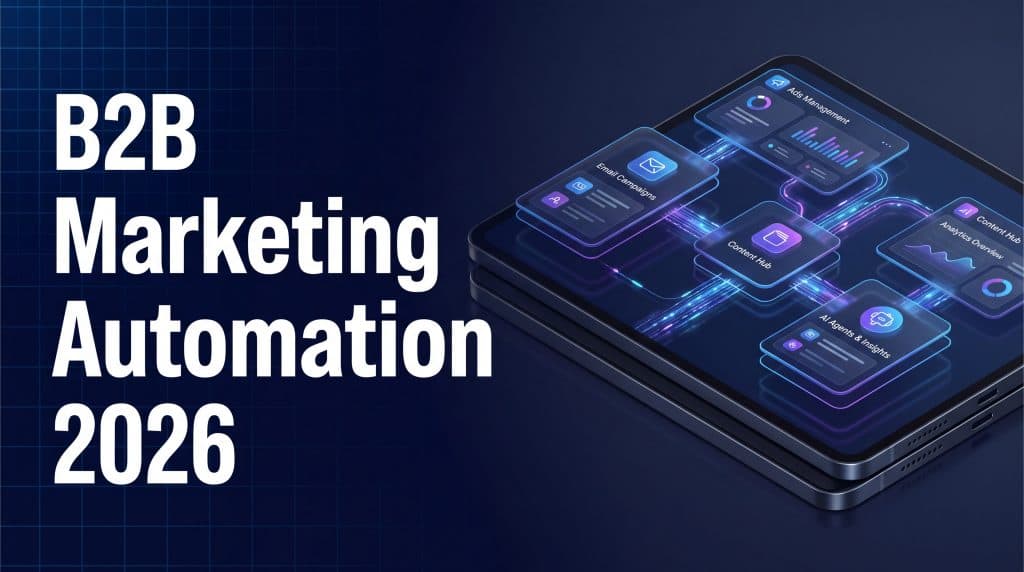
The 2026 B2B marketing automation landscape: from rigid workflows to agentic, brand-intelligent execution.