TL;DR
- Generative AI marketing has moved from novelty to default workflow. 87% of marketers now use it in at least one workflow, up from 51% in 2024.
- Median payback on AI marketing tooling is now 4.2 months. Top performers report up to 420% ROI on content creation use cases.
- The biggest gap is execution, not enthusiasm. Only 29% of organizations see significant enterprise ROI, mostly because of fragmented tools, weak governance, and brand-voice drift.
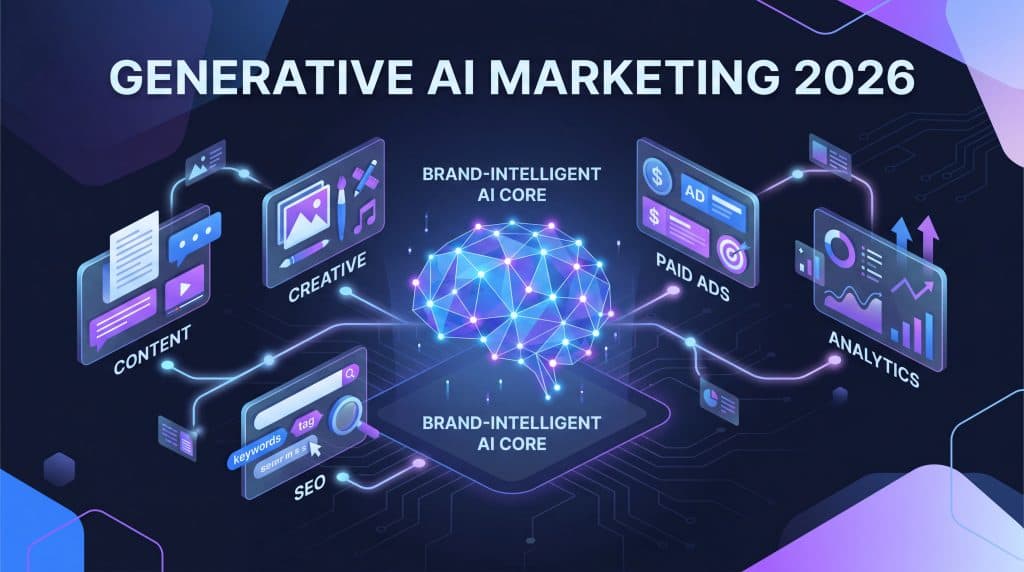
- The winning operating model unifies creative, SEO, paid, and analytics under one brand intelligence layer rather than stitching together 7+ point solutions.
- Brand safety and hallucination risk are the new oversight priorities. Human-in-the-loop review is now standard at 76% of enterprises.
Table of Contents
- What is generative AI marketing?
- The state of generative AI marketing in 2026
- Top generative AI marketing use cases
- Real-world examples from leading brands
- The ROI math: what good looks like
- Building your generative AI marketing stack
- Risks, governance, and brand safety
- A 90-day rollout roadmap
- Frequently asked questions
What is generative AI marketing?
Generative AI marketing is the practice of using foundation models, large language models, and image, video, and audio generators to produce, personalize, and optimize marketing assets across every channel. Unlike traditional marketing automation, which routes static content based on rules, generative AI creates the content itself: ad copy, landing page variants, product descriptions, SEO articles, lifecycle emails, social posts, hero images, video cuts, and dynamic creative for paid media.
The shift matters because marketing has always been bottlenecked by production capacity. A typical mid-market team ships dozens of campaigns a year because every variant, every translation, every channel-specific cut had to be hand-built. Generative AI removes that ceiling. The same team can now produce hundreds of personalized variants in the time it used to take to make one. That changes the unit economics of the entire function. For a deeper view on how this reshapes team structure, see our AI marketing strategy framework.
What people often miss is that generative AI is not one technology. It is a stack: foundation models for language and vision, retrieval and grounding systems that keep output on-brand and factually accurate, orchestration layers that decide which model to use for which task, and a workflow surface that lets humans review, edit, and publish. Treating it as a single tool is the most common reason rollouts disappoint.
The state of generative AI marketing in 2026
The headline number every marketing leader cites this year is that 87% of marketers now use generative AI in at least one workflow, up from 51% in 2024. US adoption sits at 84%, leading the global average of 78%. Inside agencies and in-house teams, 66% of marketers say they use AI tools on most or all of their projects, and 77% of those who use generative AI apply it specifically to creative development.
McKinsey estimate of annual marketing productivity gains unlocked by generative AI, equivalent to 5 to 15 percent of total global marketing spend.
The ROI picture is more nuanced than the adoption story suggests. CMOs are largely positive: 93% report clear ROI, with an average return of 340% reported within 18 months and a median payback now down to 4.2 months from 7.8 months in 2024. Content creation tools deliver the highest return at roughly 420%, financial services lead industries at 4.2x return per dollar invested, and agentic systems are accelerating campaign creation and execution by 10 to 15 times.
But there is a flip side. Only 29% of organizations report significant ROI at the enterprise level, even though 97% of executives report some individual benefit. Nearly 60% have seen no enterprise-wide financial impact from generative AI yet. The gap is almost never about the technology. It is about fragmented tools, brand drift, weak governance, and a lack of unified data, which is exactly the problem a marketing intelligence platform is built to solve.
Top generative AI marketing use cases
The most valuable applications cluster into seven categories. The teams getting outsized returns are running three or more of these in parallel, not just one.
1. Content production at scale
Long-form SEO articles, product descriptions, knowledge base entries, and educational content drafted in minutes instead of days. The trick is grounding output in real brand data, factual sources, and a documented voice. Without grounding, you ship plausible but generic copy that reads like every other AI-written page on the internet. Our AI copywriting guide walks through the specific prompt and grounding patterns that separate usable output from filler.
2. Creative and visual generation
Hero images, ad creative, social cuts, product mockups, and video b-roll generated from brief and brand kit. The mature pattern combines generative image models with brand intelligence systems that lock down colors, typography, and composition rules so every output is on-brand by default. See our deep dive on creative automation for the operating model that makes this scalable.
3. Personalization at scale
One-to-one variants of landing pages, emails, and ad creative tuned by segment, intent signal, and behavior. The economic upside is real: McKinsey reports 10 to 30 percent revenue growth for teams running hyperpersonalized programs. The execution challenge is keeping it brand-safe across thousands of variants, which is where a strong AI personalization framework earns its keep.
4. Paid media optimization
Dynamic creative optimization for Performance Max and Advantage+, headline and description generation, audience expansion, and budget rebalancing. AI-driven DCO is now the default expectation for any team running broad-match or AI-bidded campaigns. Read the practical playbook in our AI dynamic creative optimization guide.
5. SEO and AI search visibility
Topic clustering, keyword research, on-page optimization, and the newer discipline of getting your brand surfaced in ChatGPT, Claude, Gemini, and Perplexity answers. Generative engine optimization is no longer optional once 30 to 50 percent of buyer research happens inside AI assistants. Start with our explainer on generative engine optimization services and AI search visibility tools.
6. Customer service and conversational marketing
AI agents that handle pre-purchase questions, qualify leads, book demos, and triage support tickets. The line between marketing and service is blurring fast. For the marketing-led view of what is possible, see our coverage of AI agents for marketing.
7. Insights, analytics, and reporting
Natural-language interrogation of dashboards, automated commentary on weekly performance, attribution analysis, and synthetic audience testing. Generative AI is becoming the layer that turns dashboards from data into decisions. Our guide on AI marketing analytics covers the patterns that actually move pipeline.
Operating insight: the teams winning with generative AI are the ones that consolidated their stack first. Running content, ads, SEO, and analytics through one brand-intelligent system delivers compounding returns because the same brand DNA, the same first-party data, and the same review workflow apply across every channel. Running seven point tools in parallel typically delivers seven disconnected experiments and a brand-voice problem.
Real-world examples from leading brands
Theory is useful, but the brands actually shipping in production tell a clearer story.
Coca-Cola has run multiple generative AI campaigns at global scale, starting with the “Masterpiece” project in partnership with Stability AI and the consumer-facing “Create Real Magic” platform built on GPT-4 and DALL-E. In late 2024 the company recreated its 1990s “Holidays Are Coming” commercial entirely with generative AI, and the brand’s global creative VP reported the holiday ad “scored off the charts” with consumers. Coca-Cola has since formalized the practice with Fizzion, an internal AI-governed creativity system designed for global brand consistency.
Klarna publicly attributed roughly $10 million in annual marketing savings to generative AI tooling, mostly from reduced image production and translation costs while shipping more variants per market.
Heinz ran one of the earliest viral generative AI campaigns, asking image models to “draw ketchup” and noting that the bottle silhouette returned was unmistakably Heinz, then turning that experiment into paid creative. The campaign worked precisely because it leaned into brand iconography, not away from it.
Mattel uses generative AI in concept and product design for toy lines, accelerating iteration cycles that used to take weeks down to hours.
The common thread is that every one of these brands built a governance layer first and ran consumer-facing creative through it. None of them are using raw model output. They are using model output filtered through brand systems, legal review, and senior creative leads.
The ROI math: what good looks like
Marketing leaders evaluating generative AI investment should anchor on three numbers: payback period, content velocity, and brand-safe variant ratio.
Benchmark to beat: 4.2 months payback, 6x faster content output, and 95%+ of generated assets passing brand review without manual edits. Teams that hit these three numbers consistently report enterprise-level ROI within a year.
Payback period has tightened dramatically. The 7.8-month average from 2024 has collapsed to 4.2 months in 2026 because foundation model costs are falling, output quality has improved, and integration tooling has matured. Anything above 6 months in 2026 likely points to a tooling or process issue rather than a fundamental ROI problem.
Content velocity is the simplest leading indicator. If your team is not producing at least 4x to 6x its pre-AI output by month three, the bottleneck is usually review and approval, not generation. The fix is almost always a tighter brand-intelligence layer that produces approval-ready output the first time, not faster generation of work that still needs heavy editing. The economics get particularly compelling when you compare the cost of running a fragmented stack against a unified one. We unpack this in the marketing tech stack guide.
Brand-safe variant ratio is the metric that most teams ignore until it bites them. If even 5 percent of generated output goes off-brand, scaling to thousands of variants per week creates an unmanageable review queue. The ratio you want is 95%+ approved on first pass, which is only possible with a documented brand voice, locked-down creative rules, and a model orchestration layer that enforces them. The patterns that get teams there are covered in our brand guidelines template.
Building your generative AI marketing stack
The most expensive mistake in 2026 is buying seven point tools because each one solves a specific use case. The teams reporting the highest ROI standardized on one unified platform that runs content, SEO, paid, and creative through a shared brand intelligence layer. The reason is mechanical: every additional tool adds an integration cost, a data silo, a separate review queue, and a new place for brand voice to drift.
A modern generative AI marketing stack has four layers:
- Brand intelligence layer. Documented voice, locked creative rules, first-party data, ICP definitions, and approved sources. This is the grounding context every model call uses.
- Multi-model AI pipeline. Different models excel at different jobs. The best stacks orchestrate across GPT, Claude, Gemini, image models, and video models rather than locking to one vendor.
- Workflow surface. Where humans brief, review, edit, approve, and publish. Without a single workflow surface, every channel ends up with its own queue.
- Measurement and feedback loop. Performance data from ads, SEO, and lifecycle feeds back into prompts, variants, and the next round of generation.
If you are still evaluating tooling, our roundup of the best AI marketing tools walks through the trade-offs across categories. MarqOps unifies these four layers so a single workflow produces brand-perfect creative, SEO content, paid variants, and analytics commentary from one dashboard, replacing seven or more specialized tools.
Risks, governance, and brand safety
The risk landscape has matured along with the tools. Three risks dominate every CMO conversation in 2026.
Hallucinations and factual drift. Even the best frontier models still fabricate facts at small but non-zero rates. Recent benchmarks show Gemini 2.0 hallucinating around 0.7 percent of the time and GPT-4o at roughly 1.5 percent. At scale, that translates to thousands of customer-facing claims per year that need verification. Customers blame the brand, not the model.
Shadow AI. Marketing teams adopting tools without IT approval, interns pasting customer data into free chatbots, and departments building automations that bypass governance. The IAB State of Data 2026 report found only 37% of marketers include AI governance clauses in vendor contracts.
Brand-adjacent risk. 53% of US media experts named proximity to generative AI content as a top brand safety challenge for 2026. The concern is not just the ads themselves, but the AI-generated content next to which they appear.
The mitigation pattern that works is straightforward: 76% of enterprises now run human-in-the-loop review for any customer-facing output, document an explicit AI usage policy, require vendor governance clauses, and centralize generation in tools that log every prompt, model call, and approval decision. Audit trails matter more in 2026 than they did in 2024 because legal and procurement teams are catching up.
A 90-day rollout roadmap
For marketing leaders starting or accelerating a generative AI program, this is the rollout sequence that actually ships value.
Days 1 to 30: Foundation
Document the brand voice in machine-readable form. Inventory current tools and identify consolidation opportunities. Pick one high-volume content workflow as the pilot, typically blog production, ad copy, or lifecycle email. Define success metrics: velocity, approval rate, and channel performance lift.
Days 31 to 60: Pilot
Run the pilot workflow end-to-end on a unified platform. Track every output through approval and into market. Measure first-pass approval rate, edit time, and performance against the pre-AI baseline. Tune prompts, grounding, and brand rules based on review feedback. The goal is 4x velocity and 90%+ first-pass approval by day 60.
Days 61 to 90: Scale
Extend to two adjacent workflows (typically ads or SEO if you started with content). Standardize review playbooks across teams. Begin retiring redundant point tools. Establish governance: AI usage policy, vendor clauses, audit logging. Report enterprise ROI to leadership using the velocity, payback, and brand-safe ratio metrics. For teams running this in a B2B context, our B2B marketing automation guide covers the workflow patterns specific to longer sales cycles.

The 2026 state of generative AI marketing: adoption, ROI, and top use cases at a glance.
Frequently asked questions
What is the difference between AI marketing and generative AI marketing?
AI marketing is the broader category covering predictive models, classification, recommendation engines, and rules-based automation. Generative AI marketing is the subset where AI creates the actual content, creative, or output. Generative AI sits on top of the broader AI marketing stack and is the layer responsible for the velocity gains most teams report.
How much does generative AI marketing tooling actually cost in 2026?
Point-tool stacks run $5,000 to $25,000 per month for mid-market teams once you total content, image, video, ads, SEO, analytics, and orchestration tools. Unified platforms typically land 40 to 60 percent below that because they consolidate seven or more tools into one. Payback is now averaging 4.2 months either way, but unified stacks compound faster because brand voice and data flow across every workflow.
Will generative AI replace marketing teams?
No, but it will reshape them. The teams reporting the strongest ROI in 2026 are roughly the same headcount as 2024, but they ship 5 to 10 times more output, run more channels, and operate more campaigns simultaneously. Roles are shifting toward editing, strategy, and brand stewardship rather than production. Junior production roles are evolving toward AI-assisted producer roles.
How do I keep generative AI output on-brand?
Three things consistently work. First, document the brand voice, color, typography, and creative rules in machine-readable form. Second, ground every model call in real brand data and approved sources rather than relying on the model’s training. Third, route everything through a single workflow surface with first-pass review so brand drift is caught before publish. Platforms with built-in Brand Intelligence DNA, like MarqOps, automate all three.
Where should a marketing team start with generative AI in 2026?
Start with one high-volume content workflow where velocity is the bottleneck, typically SEO content production or paid ad variants. Pilot it on a unified platform rather than a single point tool so you can extend to adjacent workflows once it is working. Aim for 4x velocity and 90%+ first-pass approval inside 60 days. Then scale to ads, SEO, and analytics commentary. The full sequence is in the 90-day roadmap above.