Marketing Tech Stack: The 2026 Guide to Building a Lean, AI-Powered Martech Engine
Updated April 2026 – 12 minute read
TL;DR
- The average enterprise now juggles 91 to 120 martech tools, and 44% of marketers run 5+ disconnected platforms – the result is data silos, wasted budget, and slow campaigns.
- A modern marketing tech stack is built in 5 layers: data, engagement, analytics, activation, and an AI agent layer that connects everything.
- Consolidation is the #1 goal for 2026 CMOs. Stack sprawl is the defining martech challenge of the year, and finance teams now demand direct ROI per tool.
- AI agents are repricing the stack, not collapsing it – they execute multi-step campaigns inside guardrails, but only on clean, connected data.
- You can build your stack the lean way: pick tools by job-to-be-done, run 30-day pilots tied to pipeline metrics, and replace 7+ point tools with one brand-intelligent platform like MarqOps.
Table of Contents
- What Is a Marketing Tech Stack?
- Why Your 2026 Marketing Tech Stack Is Different
- The 5 Layers of a Modern Martech Stack
- Marketing Tech Stack Examples (B2B, B2C, Agency)
- Marketing Tech Stack Diagram and Template
- How to Build Your Stack in 7 Steps
- The AI Marketing Tech Stack: Agents, Not Apps
- Stack Consolidation: From 7+ Tools to 1 Platform
- 5 Mistakes That Wreck Most Martech Stacks
- FAQs
What Is a Marketing Tech Stack?
A marketing tech stack (or martech stack) is the collection of software platforms a marketing team uses to plan, run, measure, and optimize campaigns. Think CRM, customer data platform, marketing automation, content management, SEO and creative tools, paid media platforms, analytics, and increasingly, AI agents. The full marketing tech stack is the operating system your team runs on every day.
Here is the practical definition: if a tool collects customer data, creates content, distributes a campaign, or measures the result, it is part of your marketing tech stack. The bigger your stack gets, the more important it becomes that those tools talk to each other, share a single view of the customer, and roll up to one number your CFO can trust. That is where most teams break down.
Modern marketing leaders treat the stack as a strategic asset, not a shopping list. The platforms you choose shape how fast you ship campaigns, how cleanly your data flows, and how much of your team’s day is wasted on tab-switching. If you are revisiting your stack in 2026, you are in good company – this is the year most teams are tearing it apart and rebuilding it leaner. Our marketing operations guide walks through how to align ops processes with the stack rebuild.
Why Your 2026 Marketing Tech Stack Is Different
Three forces have rewritten the rules for what a strong marketing tech stack looks like in 2026: data gravity, AI agents, and the CFO. Combined, they have flipped the buying motion from “find the best point tool for every job” to “consolidate around the platform that owns my customer data and runs work autonomously.”
The numbers behind the chaos
- There are 15,384 martech solutions on the market in 2024, up from 150 in 2011 (Statista, chiefmartec).
- The average enterprise uses 91 to 120 marketing cloud services.
- 44% of marketers have 5+ tools in their stack, but the average marketer only uses 3 weekly.
- CMOs allocate roughly 20-30% of total marketing budget to martech.
- Only 39% of companies are actively experimenting with AI agents inside their stack.
The pattern is obvious. Teams keep buying tools, never sunset the old ones, and end up paying for licenses no one logs into. Stack sprawl is now the defining martech challenge of 2026. Buyers are responding by collapsing categories: customer data platforms are absorbing CRM functionality, marketing clouds are eating CDPs, and a new layer of AI agents sits on top of everything to actually do the work.
CFOs have caught on. Marketing leaders are no longer allowed to bring vague engagement metrics to budget reviews. Every dollar of martech spend now needs to map to pipeline created, CAC reduced, or cycle time saved. That single shift is what is forcing the modern marketing tech stack to look more like a tightly integrated platform and less like a Frankenstein.
The 5 Layers of a Modern Martech Stack
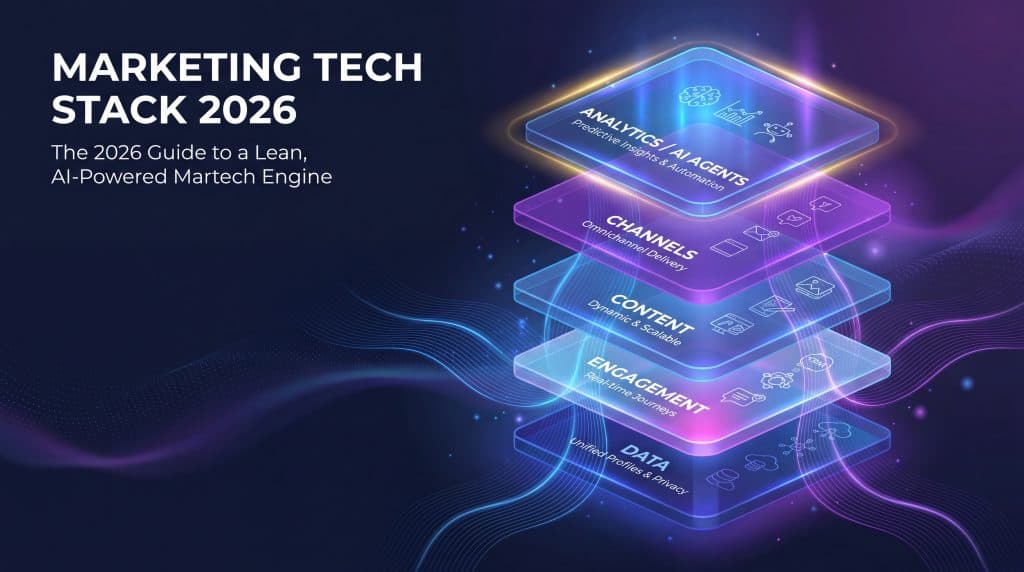
A clean marketing tech stack is best understood as 5 layers stacked on top of each other. Every great stack covers all 5, even if one tool spans multiple layers.
Layer 1: Data Foundation
This is your single source of truth for customer data. It includes CRM (HubSpot, Salesforce), customer data platform (Segment, mParticle, RudderStack), and increasingly, the cloud data warehouse itself (Snowflake, BigQuery, Databricks). In 2026 the strongest stacks treat the warehouse as the foundation, with composable CDPs working directly on warehouse data instead of duplicating it. Without a clean data layer, every layer above it inherits the mess.
Layer 2: Engagement and Orchestration
Where you actually ship work. Marketing automation (Marketo, HubSpot, Customer.io), email service providers, push and SMS platforms, in-app messaging, and journey orchestration tools live here. This is where most teams have the worst tool overlap. If your CRM, your MAP, and your CDP can each send an email, you have a coordination problem. See our best marketing automation tools comparison for how the leaders stack up this year.
Layer 3: Content and Creative
CMS, DAM, creative production, AI image and video generation, brand management, and the SEO content workflow all sit here. This is the layer most disrupted by AI in 2026. Where a team needed 4 separate platforms a year ago – copywriter, designer, brand reviewer, and SEO checker – one brand-intelligent platform now produces brand-perfect content from a single brief. Our creative automation guide goes deeper here.
Layer 4: Channels and Activation
The platforms that actually distribute campaigns: Google Ads, Meta, LinkedIn, TikTok, programmatic DSPs, retail media networks, affiliate platforms, and SEO platforms. Most stacks underinvest in tools that unify activation across channels. Without a single planning surface, your paid social team and your search team end up bidding against each other for the same audience.
Layer 5: Analytics and Intelligence
Web analytics, product analytics, attribution, marketing mix modeling, BI dashboards, and the new AI agent layer. This is where data from layers 1 through 4 gets turned into decisions. Strong teams in 2026 are running multi-touch attribution alongside marketing mix modeling and incrementality testing – not picking one. Our multi-touch attribution guide and predictive marketing analytics playbook cover the modern measurement stack in detail.
Marketing Tech Stack Examples by Company Type
There is no universal stack. The best marketing tech stack examples vary by business model, sales motion, and team size. Here is what high-performing teams actually run in 2026.
B2B Marketing Tech Stack (mid-market, sales-led)
Data: Salesforce or HubSpot CRM, Snowflake warehouse, Hightouch or Census reverse ETL. Engagement: HubSpot Marketing Hub or Marketo for nurture, Outreach or Salesloft for sales engagement, Apollo or ZoomInfo for prospect data. Content: Webflow or WordPress CMS, Frame.io for video review. Channels: Google Ads, LinkedIn Ads, 6sense or Demandbase for ABM. Analytics: GA4, Dreamdata or HockeyStack for B2B attribution, Looker for BI. AI layer: an AI agent platform that runs SEO content, ad creative, and reporting on top of the stack. The b2b marketing tech stack is the densest because it has to coordinate marketing, SDRs, AEs, and customer success.
B2C / DTC Marketing Tech Stack
Data: Shopify or commerce platform as system of record, Segment or RudderStack CDP, Snowflake warehouse. Engagement: Klaviyo or Customer.io for email and SMS, Attentive for SMS at scale, Postscript for ecommerce-specific flows. Content: Shopify CMS, AI creative platform, brand DAM. Channels: Meta, Google, TikTok, retail media, influencer platforms. Analytics: Triple Whale or Northbeam for ecommerce attribution, GA4, BI tool. The DTC stack is biased heavily toward channels and creative volume – the engagement loop is faster and more performance-driven.
Agency Marketing Tech Stack
Agencies need scale and brand isolation. The strongest agency stacks are unified platforms that can host 20+ client brands, switch context cleanly, and produce on-brand creative at volume. That is exactly the use case AI-first platforms were built for – one login, every client’s brand voice, every channel.
SaaS Marketing Tech Stack (PLG)
Product-led companies bias toward product analytics (Amplitude, Mixpanel, PostHog), in-app guidance (Pendo, Appcues), and lifecycle messaging (Customer.io, Userlist). The CRM is often lighter, but the warehouse and product analytics platforms have to be tier-1.

Marketing tech stack diagram: 5 layers, from data foundation to AI activation.
Marketing Tech Stack Diagram and Template
A clean marketing tech stack diagram should fit on one page. If it doesn’t, your stack is too complex. Use this martech stack template to map what you have today before you decide what to add or cut.
Martech Stack Template – 5 Boxes
- Data Layer – CRM, CDP, warehouse, identity resolution
- Engagement Layer – MAP, ESP, push, SMS, in-app, journey
- Content and Creative – CMS, DAM, AI creative, brand engine
- Channels and Activation – paid, organic, social, ABM, programmatic
- Analytics and AI Agents – BI, attribution, MMM, agent layer
For each box, write down: tool name, monthly cost, primary owner, what data flows in, what data flows out, and last login date for the team. The last column is the most useful – any tool no one has logged into in 60 days is a candidate to cut. This simple marketing tech stack diagram exercise typically surfaces 3 to 5 tools per audit that can be sunset immediately.
How to Build Your Marketing Tech Stack in 7 Steps
Whether you are starting from zero or rebuilding a bloated stack, the buying motion in 2026 follows the same 7 steps. Buy by job-to-be-done, not by category brochures.
- Audit what you have. List every tool, the monthly cost, and the actual usage. Most teams find 20-40% of spend is on tools no one uses.
- Map jobs to layers. For each of the 5 layers, write the top 3 jobs you need done. Skip categories you don’t actually need.
- Set evaluation criteria. Use case fit, integrations, data and PII handling, AI transparency, time-to-value, total cost of ownership, vendor roadmap, peer proof.
- Shortlist by category. Pull 3 vendors per shortlist. Eliminate any that can’t show clear ROI math in their first sales call.
- Pilot for 30 days against pipeline metrics. SQL rate, pipeline created, win rate, CAC payback, LTV:CAC. Not opens or clicks.
- Cut as you add. Every new tool replaces something. If it is purely additive, you are bloating your stack again.
- Document and review quarterly. Keep a living martech stack diagram. Re-audit every 90 days. Tools that don’t move revenue lose their seat.
The AI Marketing Tech Stack: Agents, Not Apps
In 2026 the biggest shift in martech isn’t a new app. It is AI agents that sit across your existing stack and execute work autonomously. Your AI marketing tech stack is no longer about which AI feature each app has bolted on. It is about which agents can run end-to-end campaigns inside your guardrails.
An AI agent for marketing doesn’t just suggest a subject line. It analyzes performance data, drafts the email, runs it through brand review, sets up the send, monitors deliverability, and replans the next send based on results – all without a human clicking through 4 different tools. Our guide to AI agents for marketing goes deeper into how this layer works.
For your stack, this means three practical changes. First, you need a brand intelligence layer – a single source of brand truth (voice, visuals, messaging pillars) that agents reference for every output. Second, you need clean, connected data, because agents trained on dirty data produce on-brand garbage at scale. Third, you need a single platform that owns the agent layer rather than 5 disconnected agents from 5 different vendors arguing over your customer data. Our marketing intelligence platform guide and brand guidelines template show how to set this up.
Stack Consolidation: From 7+ Tools to 1 Platform
The reason CMOs name “stack consolidation” as their top priority for 2026 is simple math. The typical mid-market marketing team is paying for separate tools to handle creative production, SEO content, ad creative, social posts, landing pages, analytics, and brand review. That is 7+ subscriptions, 7+ logins, 7+ vendor management relationships, and a brand identity that drifts every time a new tool generates output.
A consolidated, brand-intelligent platform replaces that entire row. MarqOps was built specifically for this collapse. One brand DNA, fed into every output. One dashboard for analytics, ads, SEO, and creative – no more tab-switching. Six times faster content production because the brand context never has to be re-explained. Enterprise-grade security with SOC 2 compliance and GDPR readiness. The result is the same workflow your team is doing today, minus the friction.
If your stack still looks like a list of point tools loosely glued together with Zapier, this is the year to consolidate. The vendors winning in 2026 are not the ones with the most features – they are the ones that integrate deeply, show real ROI, and replace 7+ other tools without forcing you to give up flexibility. Start with our 2026 AI marketing tools roundup to see how the consolidation play looks across the market.
Ready to consolidate your marketing tech stack?
MarqOps replaces 7+ disconnected tools with one brand-intelligent platform. Start free, no card required.
5 Mistakes That Wreck Most Martech Stacks
After auditing dozens of stacks across mid-market and enterprise teams, the same five mistakes show up almost every time. Watch for these in your own marketing tech stack rebuild.
- Buying tools, not outcomes. Teams pick the platform with the best demo, not the one with the cleanest path to pipeline. Always ask: which revenue metric does this move?
- No data layer. Without a CDP or warehouse-as-CDP, every downstream tool builds its own version of the customer. You end up with 4 truths and 0 trust. See our AI personalization guide for the data flow that makes targeting actually work.
- Treating AI as a feature, not a layer. If your “AI strategy” is the AI button inside each app, you have no AI strategy. Pick one agent layer that runs across the stack.
- No sunset discipline. Tools live forever in most stacks because no one is responsible for killing them. Assign a stack owner with quarterly cut authority.
- Ignoring brand drift. The more tools generate content, the faster your brand goes out of voice. Bake brand intelligence into the data layer, not the review step. Our AI content strategy guide shows how to operationalize this.
Marketing Tech Stack FAQs
What is a marketing tech stack in simple terms?
A marketing tech stack is the bundle of software platforms a marketing team uses to plan, run, measure, and optimize campaigns. It usually spans 5 layers: customer data, engagement and orchestration, content and creative, channels and activation, and analytics and AI. The “stack” metaphor matters because each layer depends on the one below it – a great engagement tool sitting on dirty data still produces bad campaigns.
How big should my marketing tech stack be?
Smaller than you think. The average enterprise uses 91 to 120 tools, but most use fewer than 10 weekly. A lean 2026 marketing tech stack for a mid-market team is typically 8 to 15 tools that cover all 5 layers, with one platform owning the AI agent layer across them. If your stack is 30+ tools, you are paying for shelfware and building data silos.
What is the difference between a CDP and a CRM in a marketing tech stack?
A CRM stores contacts, accounts, and the interactions sales and marketing have with them – it is built for relationship management. A CDP unifies behavioral, transactional, and identity data from every customer-facing system into one persistent profile that any marketing tool can activate. They are complementary: the CRM owns “who they are and what we said,” and the CDP owns “what they did, everywhere.” A modern marketing tech stack uses both, ideally feeding off the same warehouse.
How much should a marketing tech stack cost?
Industry benchmarks put martech at 20-30% of total marketing budget, with marketing itself running around 7-10% of revenue. So a $100M revenue company budgeting 8% to marketing and 25% of that to martech is spending around $2M per year on tools. The real question is not the dollar amount, it is whether each tool maps to pipeline, CAC reduction, or cycle time saved. CFOs in 2026 will reject any line item that can’t.
What is an AI marketing tech stack?
An AI marketing tech stack is a martech stack designed around AI agents that execute work autonomously, not just AI features bolted onto each app. The defining shift is the agent layer that sits across data, engagement, content, and analytics, running multi-step campaigns inside human-defined guardrails. The strongest AI marketing tech stacks in 2026 are built on consolidated platforms that share one source of customer data and one source of brand truth – that is what lets agents produce work that is both fast and on-brand.