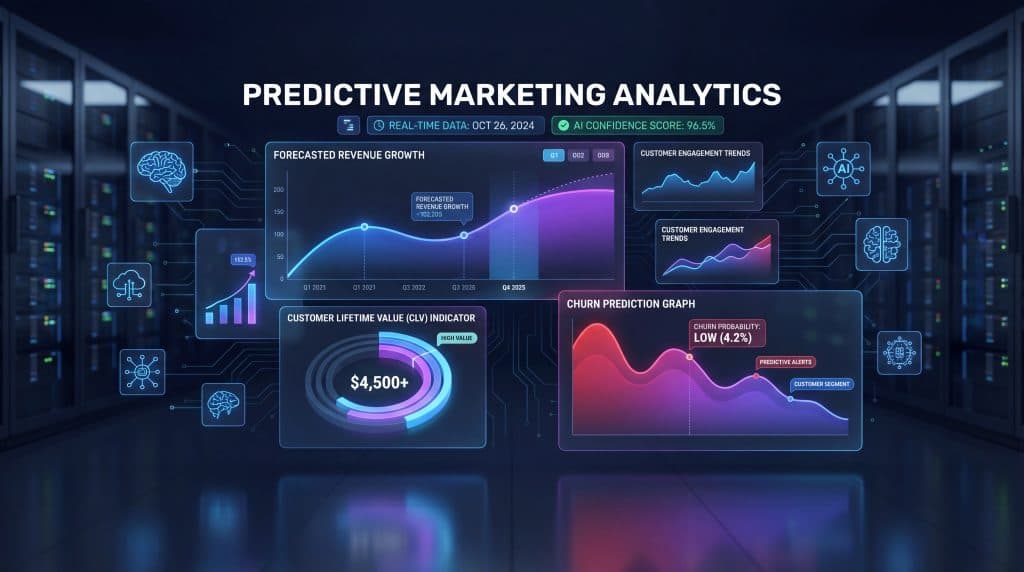
Predictive Marketing Analytics: The 2026 Playbook for Forecasting ROI, Churn, and Customer Value
Updated April 2026 | 14 minute read
Predictive marketing analytics has moved from a nice to have capability into the operating system of every serious growth team. The math is hard to ignore. Companies running predictive models report up to 523 percent more ROI from campaigns, 78 percent lower churn, and the ability to surface high value prospects roughly six months before traditional scoring catches them. And 74 percent of B2B marketing teams now use AI driven analytics to gain a competitive edge.
If your team still forecasts quarterly pipeline in a spreadsheet, sizes budgets off last month’s performance, or waits until a campaign ends to know whether it worked, this guide is for you. We will break down what predictive marketing analytics actually is in 2026, the use cases that are paying off right now, how to stand up your first model without a data science team, and the platforms that are making it accessible to marketing ops leaders.
TL;DR
- Predictive marketing analytics uses historical data, machine learning, and real time signals to forecast campaign performance, customer behavior, and revenue outcomes before they happen.
- Top use cases: campaign performance forecasting, predictive lead scoring, customer lifetime value modeling, churn prediction, and channel decay modeling.
- Real impact: 20 to 35 percent CLV increase, 15 to 25 percent ROI gains, 85 to 92 percent accuracy in churn prediction models, 27 percent faster sales cycles.
- You do not need a data science team. Modern platforms handle model building, training, and deployment inside marketing friendly interfaces.
- The real bottleneck is fragmented data and disconnected tools. Teams on unified platforms like MarqOps ship predictive insights 6x faster than teams stitching together seven point solutions.
Table of Contents
- What Is Predictive Marketing Analytics in 2026
- Why Predictive Analytics Matters More Than Ever
- 7 Predictive Marketing Analytics Use Cases That Actually Drive Revenue
- The 5 Core Predictive Models Every Marketing Team Should Know
- The Data Stack You Need to Get Started
- How to Launch Your First Predictive Model in 90 Days
- Top Predictive Marketing Analytics Platforms
- 5 Mistakes That Kill Predictive Analytics Projects
- How MarqOps Makes Predictive Analytics Practical
- Frequently Asked Questions
What Is Predictive Marketing Analytics in 2026
Predictive marketing analytics is the discipline of using historical data, statistical modeling, and machine learning to forecast future customer behavior, campaign performance, and revenue outcomes. Instead of describing what already happened, which is the job of traditional marketing analytics, predictive analytics tells you what is about to happen so you can act on it.
The difference is the shift from rear view mirror reporting to forward looking intelligence. A traditional dashboard tells you last quarter’s cost per lead. A predictive model tells you which leads in your pipeline right now are most likely to close in the next 30 days, which ones are about to go cold, and which campaign variant will generate the most qualified demand next quarter.
In 2026, three things have changed that make predictive analytics practical for every marketing team, not just enterprises with dedicated data scientists:
- Foundation models do the heavy lifting. Large language models and purpose built ML engines have collapsed the cost of building prediction models. What used to take a team of three data scientists six months now runs in a unified marketing platform in days.
- Real time data pipelines are cheap. Modern customer data platforms, warehouses, and streaming infrastructure have made it trivial to feed models with live behavioral data instead of stale CSV exports.
- Marketing tools speak the same language. Unified platforms are replacing the old stack of seven disconnected point tools, which means your ad data, website analytics, CRM, and content performance all live in one system where models can actually use them.
of B2B marketing teams now use AI driven analytics to gain a competitive edge
Why Predictive Analytics Matters More Than Ever
Three forces have collided to make predictive marketing analytics essential in 2026.
Media costs keep climbing. The average CPM across paid social has more than doubled since 2021. Every campaign you launch is a bigger bet than it used to be, which means the cost of guessing wrong is higher. Predictive analytics shrinks that risk by forecasting outcomes before you spend the money.
Attribution is fragmenting. Between signal loss, privacy regulations, and the walled gardens of Meta, Google, and TikTok, last click attribution is basically useless. Predictive models fill that gap by inferring incrementality and causal impact from the behavioral data you do have.
Customers expect personalization. Static segments cannot keep up with how fast buyer intent changes. Real time predictive models power the dynamic personalization that customers now treat as table stakes. If you are still sending the same email to your entire list, you are losing to competitors who are not.
For teams managing the overlap between paid media, SEO, and creative production, predictive analytics is the glue that ties forecasted outcomes back to the decisions you make every day. Our guide to AI in marketing automation covers how the broader automation layer feeds into this predictive loop.
7 Predictive Marketing Analytics Use Cases That Actually Drive Revenue
Not every predictive model delivers equal value. These seven are the ones paying back fastest in 2026.
1. Campaign Performance Forecasting
Before you spend a dollar, predictive models forecast which creative, channel, and audience combination is most likely to hit your CAC and ROAS targets. Teams using campaign forecasting report 32 percent higher lead quality and avoid wasted spend on campaigns that were doomed from the start. This is especially powerful for Performance Max campaigns where budget commits early.
2. Predictive Lead Scoring
Traditional lead scoring uses a handful of firmographic rules. Predictive scoring analyzes 50 or more behavioral and demographic attributes to output a real conversion probability. The result is a sales team that spends 27 percent less time chasing leads that will never close.
3. Customer Lifetime Value Modeling
CLV models predict the future revenue a customer will generate across their entire relationship with your brand. Teams that deploy AI powered CLV modeling see customer lifetime value increase by 20 to 35 percent because they shift budget toward the segments that actually compound.
4. Churn Prediction
Modern churn models hit 85 to 92 percent accuracy when trained on behavioral signals like engagement frequency, product usage, support interactions, and content consumption. Reducing churn by even 5 percent can lift profits by 25 to 95 percent, which is why this is usually the highest ROI model for subscription businesses.
5. Next Best Action Models
Instead of a fixed email sequence, next best action models decide in real time which message, offer, or channel each individual customer should see next. This is where AI agents for marketing start to deliver on their promise, turning static journeys into adaptive experiences.
6. Channel Decay Modeling
A 2026 trend worth watching. Channel decay models forecast diminishing returns on specific channels 12 to 18 months in advance, so you can reallocate budget before a channel runs out of runway. If Meta is still converting today but your model says it will be dead by Q3, you start diversifying now instead of panicking later.
7. Content and SEO Performance Forecasting
Predictive models also forecast which topics, keywords, and formats will drive organic traffic before you invest in content production. Combined with proven AI SEO tools, this removes the guesswork from content planning.

The 7 highest ROI predictive marketing analytics use cases in 2026
The 5 Core Predictive Models Every Marketing Team Should Know
Behind the use cases are a handful of model families that do most of the work. You do not need to build these yourself, but understanding what they do helps you choose the right tool.
Propensity models predict the likelihood a customer will take a specific action like converting, upgrading, or churning. Classification algorithms like logistic regression, random forests, and gradient boosting are the workhorses here.
Regression models predict continuous values like expected revenue, CLV, or cost per acquisition. Linear regression, Bayesian regression, and neural networks all show up in this family.
Clustering and segmentation models group customers into behaviorally similar cohorts automatically, so your targeting becomes dynamic instead of static. This is how modern platforms build micro segments that update in real time.
Time series forecasting models predict metrics across time, from weekly revenue to seasonal spend patterns. ARIMA, Prophet, and LSTM based models are common choices.
Uplift and causal models predict the incremental effect of a marketing action instead of just the raw conversion probability. This is how you tell the difference between a customer who converted because of your ad and one who would have converted anyway. These models matter more every year as attribution gets harder.
The Data Stack You Need to Get Started
Every predictive model is only as good as the data feeding it. Before you shop for a platform, make sure you have these four layers in place.
Collection. You need clean event data flowing from your website, product, app, ads, CRM, and email platform. Server side tagging, first party cookies, and consent aware tracking are now table stakes.
Storage. A warehouse like Snowflake, BigQuery, or Databricks. Or a unified platform that handles storage for you. The point is a single place where every data source lives in a queryable format.
Modeling layer. Whether you are using open source libraries, cloud ML services, or an embedded model inside your marketing platform, this is where the training and inference happens. Most marketing teams should not run this themselves. Let the platform do it.
Activation. Predictions are useless if they cannot trigger action. You need a way to push model outputs back into your campaigns, audiences, email flows, and ads. This is the step where most teams get stuck. If your stack cannot activate a predicted audience in your ad platform within minutes, the model might as well not exist.
The biggest blocker is not the model itself. It is the plumbing between disconnected tools. Teams running their marketing on 7 plus point tools spend most of their time wrangling data instead of acting on it. Unified platforms collapse that work into one system so models actually get used.
How to Launch Your First Predictive Model in 90 Days
You do not need a year long transformation program to get value from predictive marketing analytics. Here is a realistic 90 day plan that most teams can run.
Days 1 to 15: Pick one problem. Choose the single use case with the clearest business impact and the cleanest data. For most teams that is predictive lead scoring, churn prediction, or campaign performance forecasting. Do not try to do three things at once.
Days 16 to 30: Audit your data. Find out what you actually have. Look at event coverage, data quality, duplicates, and how far back your history goes. You need at least 12 months of clean historical data for most predictive models to work well.
Days 31 to 60: Build and train. Use a platform with pre built models instead of trying to build from scratch. Connect your data sources, let the platform train on your historical data, and validate the output against a holdout set. If the model beats your existing baseline by 15 percent or more, it is worth deploying.
Days 61 to 75: Activate. Push the model output into a single downstream system. If it is a lead scoring model, send the scores into your CRM. If it is a CLV model, use it to segment high value customers in your ad platform. Keep the activation narrow for the first deployment.
Days 76 to 90: Measure and iterate. Compare outcomes against your baseline. Look at both the business metric like revenue or CAC and the model metric like precision and recall. If the numbers are positive, expand the use case. If not, diagnose the data rather than blaming the model.
Top Predictive Marketing Analytics Platforms
A short rundown of the platforms that show up most often when marketing teams go shopping for predictive analytics. This is not an exhaustive list, but it covers the categories you should evaluate.
Unified marketing operations platforms. Tools like MarqOps bundle creative production, SEO, paid media, and analytics with built in predictive models. The advantage is that your data lives in one place already, so the models work out of the box instead of requiring months of integration.
Customer data platforms with native ML. Segment, Treasure Data, and Tealium added predictive features in the last two years. They are strong if your organization already invested in a CDP and you mainly need predictions feeding downstream activation.
Enterprise analytics suites. Adobe Experience Platform, Salesforce Marketing Cloud Intelligence, and SAS Customer Intelligence are the heavy hitters. They are powerful but slow to implement and priced for large teams.
Specialized predictive tools. Factors, Madkudu, and 6sense focus specifically on predictive lead scoring and intent. Pega and Blueshift focus on next best action and journey orchestration.
Open source and cloud ML. If you have data engineering resources, options like Snowflake Cortex, BigQuery ML, and Databricks let you build custom models against your warehouse. Maximum flexibility, maximum overhead.
5 Mistakes That Kill Predictive Analytics Projects
Most failed predictive analytics initiatives did not fail because the math was wrong. They failed for five predictable reasons.
1. Starting with the model instead of the decision. If you cannot name the decision the model will influence, do not build it. Every predictive project should start with a specific marketer action that the prediction unlocks.
2. Dirty or incomplete data. Missing conversion events, duplicate customer records, and inconsistent naming conventions will poison every model you build. Fix the data first. Always.
3. Treating models as set and forget. Buyer behavior shifts. Economic conditions shift. Your product shifts. Models decay, usually within 60 to 90 days. You need a retraining cadence and monitoring for concept drift, otherwise your predictions silently get worse.
4. Over investing in accuracy instead of action. A 72 percent accurate model that triggers actual campaign changes beats a 92 percent accurate model that sits in a Jupyter notebook. Optimize for activation first, accuracy second.
5. Running on 7 plus disconnected tools. The single biggest operational drag on predictive analytics is data living in silos. If your CRM cannot see your ad spend, your content platform cannot see your audience segments, and your analytics tool cannot see your CMS behavior, your models are flying half blind. This is exactly the problem unified marketing operations platforms were built to solve.
How MarqOps Makes Predictive Analytics Practical
MarqOps is built for teams who want the outcomes of predictive marketing analytics without building a data science function from scratch. Instead of bolting analytics onto a stack of 7 disconnected tools, MarqOps unifies creative production, SEO content generation, marketing analytics, and paid advertising under one brand intelligent system.
That unification is what makes predictive analytics actually usable. Because your ads, creative, content, and performance data already live in the same platform, predictive models pull from a single source of truth. No ETL pipelines. No stale CSV exports. No reconciling three dashboards that each say something different.
The Brand Intelligence DNA at the core of MarqOps means predictions are not just accurate, they are brand aware. When the system forecasts a high performing creative variant, it produces output that already matches your voice, visual identity, and compliance rules. Teams ship insights into live campaigns 6x faster compared to manual workflows built on disconnected tools.
Frequently Asked Questions
What is the difference between predictive and prescriptive marketing analytics?
Predictive analytics forecasts what is likely to happen. Prescriptive analytics goes one step further and recommends the specific action you should take to influence that outcome. Most modern platforms combine both so marketers see both the prediction and the recommended next step.
How much historical data do I need to train a predictive marketing model?
Most use cases need at least 12 months of clean historical data and a minimum of a few thousand relevant events. For churn prediction and CLV models you usually want 18 to 24 months. If you are starting from scratch, focus on data collection for 90 days before spinning up your first model.
Do I need data scientists to run predictive marketing analytics?
Not in 2026. Modern platforms handle model training, deployment, and monitoring behind marketing friendly interfaces. You still benefit from data engineering talent to keep pipelines clean, but the actual model building has been abstracted away for most common use cases.
How accurate are predictive marketing models in 2026?
Accuracy depends on the use case and data quality. Churn prediction models typically hit 85 to 92 percent accuracy. Lead scoring models reach 70 to 85 percent. CLV forecasting often lands within 15 to 25 percent of actual values. The real question is not raw accuracy but whether the model beats whatever baseline you are using today.
How is predictive analytics different from AI marketing analytics?
AI marketing analytics is a broader term that covers any use of AI to analyze marketing data, including descriptive dashboards, anomaly detection, and natural language summaries. Predictive analytics is specifically the forecasting subset, focused on modeling future outcomes instead of explaining past ones.
Can small marketing teams benefit from predictive analytics?
Yes. In fact, small teams often get the biggest relative lift because they cannot afford to waste budget on campaigns that will not perform. The key is picking a platform where the models are already built so you are not diverting scarce engineering resources.
What metrics should I track to prove predictive analytics ROI?
Track the business metric the model influences, not just model accuracy. For lead scoring that is sales velocity and conversion rate. For churn prediction that is retention rate and net revenue retention. For CLV models that is revenue per customer and payback period. Always compare against a baseline from before the model was deployed.
The Bottom Line
Predictive marketing analytics is no longer a luxury for enterprise data teams. In 2026 it is a core capability for any marketing operation that wants to compete. The teams getting value from it are not the ones with the biggest data science budgets. They are the ones who picked a focused use case, cleaned their data, and chose a platform that could turn predictions into action inside the same system where their campaigns already run.
If you are running your marketing across seven disconnected tools, your biggest bottleneck is not the model. It is the plumbing. Unified platforms like MarqOps remove that friction so your team can actually deploy the models, see the results, and keep iterating. Start with one use case, pick the decision it unlocks, and let the data do the rest.