TL;DR
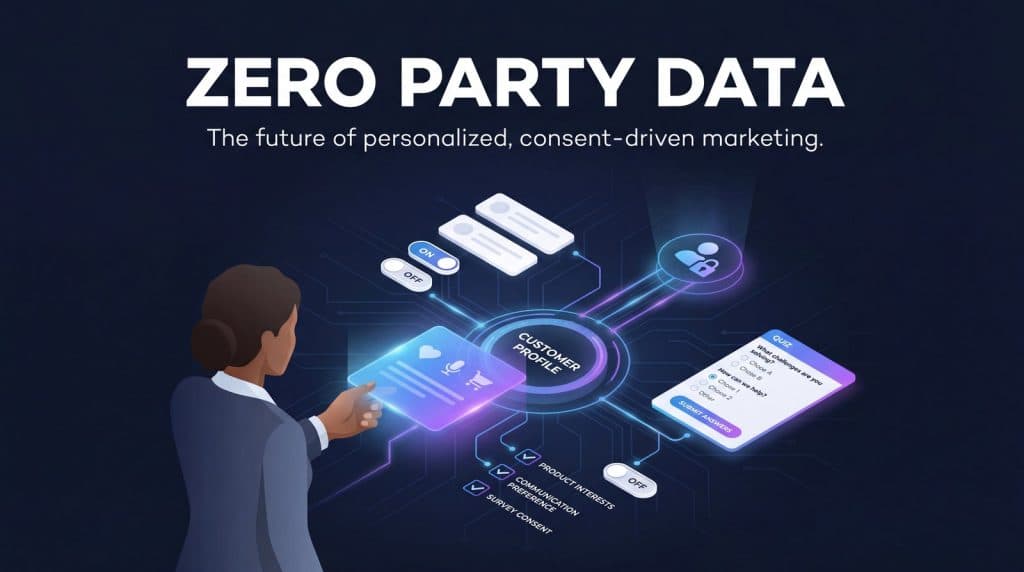
- Zero party data is information a customer intentionally and proactively shares with you: preferences, intentions, quiz answers, and stated goals. It is the most accurate and most privacy-safe data you can hold.
- With third-party cookies gone from most browsers and global privacy fines climbing, marketers are racing to own their data relationships. Zero party data sits at the top of that pyramid because consent is explicit by design.
- Zero party data is declared by the customer, while first party data is observed by you. You need both, but zero party data fills the gaps behavior cannot explain, like why someone is shopping.
- The best collection methods are value exchanges: interactive quizzes, preference centers, polls, conversational forms, and loyalty programs that reward sharing with real personalization.
- AI is what turns declared data into revenue through predictive segmentation, journey orchestration, and brand-perfect content. Platforms like MarqOps unify collection and activation in one dashboard instead of seven disconnected tools.
Table of Contents
- What Is Zero Party Data?
- Zero Party Data vs First Party Data (and Why You Need Both)
- Zero Party Data Examples That Actually Work
- Why Zero Party Data Matters More Than Ever in 2026
- 7 Proven Ways to Collect Zero Party Data
- Activating Zero Party Data with AI
- How to Build a Zero Party Data Strategy (6 Steps)
- Common Mistakes to Avoid
- Frequently Asked Questions
What Is Zero Party Data?
Zero party data is information that a customer intentionally and proactively shares with a brand. It is volunteered, not observed. When someone tells you their skin type in a product quiz, picks “weekly digest only” in a preference center, or says they are shopping for a gift rather than themselves, that is zero party data. The term was coined by Forrester, and it has become the single most valuable input in privacy-first marketing because the customer hands it to you on purpose.
The distinction matters. Most data you hold is inferred from behavior. You watch what pages someone visits and you guess what they want. Zero party data removes the guessing. Instead of inferring intent from a click, you have the customer stating it directly. That makes it the highest-confidence signal in your stack and the safest from a compliance standpoint, because consent is built into the act of sharing.
Simple test: if the customer deliberately told you something in exchange for a better experience, it is zero party data. If you watched them do something and drew a conclusion, it is first party data. Both are valuable. Only one removes the guesswork.
Forrester defines zero party data as data a customer intentionally and proactively shares, which can include preference center inputs, purchase intentions, personal context, and how the individual wants the brand to recognize them. In practice it is the difference between assuming a shopper wants running shoes because they viewed three pairs, and knowing they are training for their first marathon in October because they told you.
Zero Party Data vs First Party Data (and Why You Need Both)
The most common question marketers ask is how zero party data differs from first party data. The line is simple: zero party data is declared by the customer, first party data is observed by you. Both are collected on channels you own, both are privacy-durable, and both belong to you. The difference is the act of intent.
| Dimension | Zero Party Data | First Party Data |
|---|---|---|
| How you get it | Customer volunteers it directly | You observe behavior on your channels |
| Example | Quiz answers, preference selections, stated goals | Pages viewed, purchases, email clicks |
| Signal type | Declared intent and preference | Inferred intent and behavior |
| Accuracy | Highest confidence, but self-reported | Reliable, but requires interpretation |
| Privacy posture | Consent is explicit by design | Requires clear consent and disclosure |
| Best for | Personalization, onboarding, segmentation | Retargeting, scoring, journey mapping |
You need both because they answer different questions. First party data tells you what a customer did. Zero party data tells you why, and what they want next. A shopper who browses winter coats gives you first party data. The same shopper telling you they are moving to a colder climate gives you zero party data, and that single declaration reshapes every recommendation you make. If you are building the foundation underneath both, start with our guide to first party data strategy and pair it with the collection tactics below.
Zero Party Data Examples That Actually Work
Zero party data is easiest to understand through concrete examples. Here is what brands across industries are collecting:
- Preference center selections: content topics, email frequency, channel preferences, product categories of interest
- Quiz and assessment answers: skin type, fitness goals, budget range, use case, experience level
- Purchase intentions: shopping for self versus gift, timeline to buy, occasion, who the product is for
- Personal context: life stage, role at company, team size, current tools, pain points
- Stated goals: what success looks like, the outcome they want, the problem they are solving
- Feedback and ratings: what they liked, what they want more of, how they would describe their needs
of marketers say zero and first party data are now central to their strategy as third-party cookies disappear
The pattern across every example is the same: the customer gets something in return for sharing. A beauty quiz returns a personalized routine. A B2B onboarding form returns a tailored dashboard. The value exchange is what separates zero party data collection from an intrusive interrogation, and it is why these methods consistently outperform passive tracking.
Why Zero Party Data Matters More Than Ever in 2026
For two decades, marketing ran on borrowed signals. Third-party cookies followed users across the web and ad platforms stitched together profiles nobody consented to. That era is functionally over. Safari and Firefox block third-party cookies by default, privacy regulations now span most major economies, and the data marketers once rented is both less available and less trusted.
Zero party data is the cleanest answer to that shift. Because the customer volunteers it, you sidestep the consent ambiguity that haunts behavioral tracking. Because it is declared, it does not decay the way inferred attributes do. And because no competitor can buy it from a broker, it becomes a durable advantage rather than a commodity. Research shows 92% of organizations are increasing investment in data they own, and zero party data sits at the top of that pyramid.
There is a trust dividend too. Customers increasingly expect personalization but distrust surveillance. Zero party data resolves that tension: people are willing to share preferences when they understand the benefit and stay in control. Brands that get this right report higher engagement, lower acquisition costs, and stronger loyalty, because the relationship is built on a transparent exchange rather than quiet observation. This is the same trust logic that powers effective AI personalization in marketing.
The bottom line: zero party data is the only data type that gets more valuable as privacy rules tighten, because the act of collecting it is the act of earning consent.
7 Proven Ways to Collect Zero Party Data
Collecting zero party data is not about adding more form fields. It is about designing value exchanges that customers actually want to complete. These seven methods consistently work:
1. Interactive Quizzes and Assessments
A well-designed quiz is the highest-converting zero party data engine there is. The customer answers questions about their needs, and in return gets a personalized result: a product match, a routine, a recommendation. Each answer is a declared preference you can act on immediately and store for later.
2. Preference Centers
Instead of a single unsubscribe button, give subscribers granular control over topics, frequency, and channels. Customers who set preferences are telling you exactly how to keep them engaged, and the data feeds directly into segmentation and AI lifecycle marketing programs.
3. Conversational Forms and Chat
Conversational interfaces collect declared data without feeling like a survey. A chat that asks “what brings you here today?” turns a cold visit into a stated intent. This is one reason conversational marketing has become such an effective top-of-funnel data source.
4. Polls, Surveys, and Feedback Loops
Short, well-timed polls capture opinion and intent at the moment it matters. Post-purchase surveys reveal motivation, NPS follow-ups reveal sentiment, and content polls reveal what topics to produce next.
5. Loyalty and Rewards Programs
Loyalty programs are a structured value exchange: points and perks in return for profile details, preferences, and purchase context. Members willingly enrich their profiles over time because the rewards make it worth their while.
6. Personalized Onboarding
The signup flow is prime real estate for zero party data. Asking new users about their goals, role, and use case lets you tailor the first experience and route them into the right journey. Done well, onboarding data also sharpens downstream AI customer segmentation.
7. Gated Interactive Content
Calculators, configurators, and assessments deliver instant value in exchange for context. A pricing calculator that asks about team size and budget collects qualifying data while genuinely helping the prospect, which also strengthens demand generation efforts.

The zero party data value exchange: collect with consent, unify in one platform, activate with AI.
Activating Zero Party Data with AI
Collecting declared data is only half the equation. Data sitting in a form-builder export earns nothing. Activation is where zero party data turns into revenue, and AI is the multiplier that makes activation scale.
The most direct application is personalization. When a customer states their goals, AI can instantly assemble the right content, product set, and messaging for that individual, rather than serving a generic default. Declared preferences become the inputs for real-time recommendation engines and dynamic creative, so every touch reflects what the customer actually asked for.
The second application is segmentation and orchestration. Declared intent is a far cleaner clustering signal than inferred behavior, so AI-built segments are sharper and the resulting journeys convert better. Feeding zero party data into customer journey orchestration lets you trigger the right next step based on what the customer said they want, not just what they clicked.
The third application is content. Once you know a customer’s stated context, AI can generate brand-perfect copy and creative tuned to that context at scale. This is where a unified system pays off: MarqOps applies Brand Intelligence DNA so every AI-generated asset stays on-brand from the first draft, turning declared preferences into personalized content 6x faster than stitching tools together manually. Tie this into your broader AI marketing analytics and the loop closes: collect, activate, measure, refine.
How to Build a Zero Party Data Strategy (6 Steps)
A zero party data strategy is not a single campaign. It is an operating system for earning, storing, and using declared data. Here is a practical roadmap any marketing team can follow.
Step 1: Map the Data You Actually Need
Start with decisions, not data. List the personalization and segmentation moves you want to make, then work backward to the specific declared inputs each requires. Collecting data you will never activate erodes trust for no return.
Step 2: Design Value Exchanges
For every piece of data you want, define what the customer gets in return. The exchange should feel obviously fair: a quiz that delivers a real recommendation, a preference center that visibly improves the emails they receive.
Step 3: Unify Collection in One Place
Declared data scattered across a quiz tool, an email platform, and a survey app is nearly useless. Route everything into a single profile. A customer data platform or a unified marketing platform stitches zero and first party data into one view so activation is possible.
Step 4: Govern Consent and Transparency
Make it clear what you collect, why, and how customers can change it. Transparent governance is not just compliance, it is the trust layer that keeps people sharing. Build consent management into the collection flow rather than bolting it on later.
Step 5: Activate with AI
Connect your unified profiles to personalization, segmentation, and content generation. This is where declared data becomes revenue. Treat activation as the priority, not an afterthought, because uncollected value is the most common failure mode.
Step 6: Measure and Refine
Track which declared inputs actually move conversion and retention, then double down on the high-signal questions and retire the rest. A unified dashboard makes this loop fast, which is exactly the gap a marketing intelligence platform is built to close.
Why one platform beats seven tools: the hardest part of a zero party data strategy is not collection, it is unification and activation. When your quiz, your profiles, your segments, and your content generation live in separate apps, declared data dies in transit. MarqOps replaces 7+ disconnected tools with one brand-intelligent system, so the data a customer shares actually shapes what they see next.
Common Mistakes to Avoid
Most zero party data programs fail for predictable reasons. Avoid these and you will outperform competitors who treat declared data as an afterthought.
- Collecting without activating: the biggest waste is gathering preferences and then sending everyone the same email. If you ask, you must act, or trust collapses.
- Making the exchange feel one-sided: asking for data without offering clear value reads as an interrogation. Lead with the benefit, every time.
- Letting data sit in silos: declared data trapped in a standalone quiz tool cannot personalize anything. Unify it into a single customer profile.
- Ignoring data decay: stated preferences change. Re-ask periodically and let customers update their own profiles through a living preference center.
- Over-collecting: long forms kill completion rates. Ask only for what you will use, and collect progressively over the relationship rather than all at once.
- Treating it as a cookie replacement: zero party data is not a one-for-one swap for third-party tracking. It is a better foundation that requires a different, value-led playbook. Pair it with a sound AI marketing strategy to get full value.
Frequently Asked Questions
What is zero party data in simple terms?
Zero party data is information a customer intentionally and proactively shares with a brand, such as their preferences, intentions, and goals. Unlike data you observe from behavior, it is volunteered directly, which makes it the most accurate and most privacy-safe data you can hold.
What is the difference between zero party data and first party data?
Zero party data is declared by the customer, while first party data is observed by you. A shopper telling you they are buying a gift is zero party data; you noticing they viewed three products is first party data. Both are collected on channels you own and both are privacy-durable, but only zero party data removes the guesswork about intent.
What are examples of zero party data?
Common examples include quiz and assessment answers, preference center selections, purchase intentions like shopping for a gift versus yourself, stated goals, life-stage context, and survey feedback. The unifying trait is that the customer chose to share it in exchange for a better experience.
Is zero party data better than first party data?
Neither is strictly better; they answer different questions and work best together. Zero party data carries the highest-confidence intent signal because it is declared, but it is self-reported. First party data is reliable observed behavior that needs interpretation. A complete strategy unifies both into a single customer profile.
How do you collect zero party data without hurting conversion?
Design a clear value exchange and collect progressively. Interactive quizzes, preference centers, conversational forms, and loyalty programs work because the customer gets something useful in return. Ask only for data you will actually activate, keep forms short, and let customers update their preferences over time rather than demanding everything upfront.
Turn Declared Data Into Revenue
Zero party data is the rare asset that gets more valuable as privacy rules tighten, because collecting it is the act of earning consent. The brands that win are not the ones who collect the most, they are the ones who activate fastest. That means unifying collection, segmentation, and brand-perfect content in one place instead of stitching together seven tools and watching declared data die in transit.